Showing posts with label 1969. Show all posts

Thursday, March 23, 2023

December 4-7, 1969 Fillmore West, San Francisco, CA: Grateful Dead/The Flock/Humble Pie (x-Altamont)


A Bill Graham Presents flyer with the poster for the December 4-7, 1969 concert at Fillmore West, headlined by the Grateful Dead. On the back was a list of upcoming concerts, including Jefferson Airplane on New Year's Eve at Winterland

Here's a Grateful Dead trivia question: when did Sam Cutler first speak on stage prior to a Grateful Dead concert? I'm pretty sure that it was Thursday, December 4, 1969 at Fillmore West. At the time, he was the road manager of the Rolling Stones. Cutler was in town with the Stones because they were planning a gigantic free concert in the San Francisco Bay Area. Cutler had apparently arrived the day before (December 3), and by Thursday it appeared that the concert would be held at the recently-opened Sears Point Raceway, at Highway 37 and 121 in the Sonoma hills. On the existing tape from December 4, an unknown announcer says "Sam Cutler told you what was going on." Presumably Cutler had come on stage earlier to talk to the crowd. It was ironic that it would shortly become part of his job description, but neither Cutler nor anyone else could have foretold that.

The Grateful Dead's four-night stand at the Fillmore West, from December 4 through 7, was their fourth weekend booking at Fillmore West in 1969. Even though Fillmore West was the Dead's home court, so to speak, any reflections on the weekend are usually swallowed up by contemplation of the ensuing debacle of a concert at Altamont Speedway on Saturday, December 6. Indeed, the Dead’s Saturday night performance at Fillmore West was canceled, since the Dead were at the racetrack and most of the fans were too. It was a strange footnote that as things fell apart, the helicopters returned the band to Fillmore West, but the Dead didn't play that Saturday night.

For all the monumental importance of Altamont, however, the December Fillmore West shows remain a cipher. We only hear about Saturday night, when the Dead helicoptered back to San Francisco and didn't perform. We hear nothing at all about Thursday, Friday or Sunday. Sure, we have the tapes. Yet the tapes tell us the music that was played--always welcome--with no other context. Were the shows well attended?  How many people went to Fillmore West one of those nights, and also went to Altamont? I cannot find any trace of eyewitnesses.

This post will illuminate what we can about the actual events at the Fillmore West on the weekend of December 4-7, 1969. At the very least, the limited known facts are still indicators of trends and portents in the arc of Grateful Dead concert history. This post will look at what the how the weekend at Fillmore West shows us about how Grateful Dead concerts were evolving, without addressing the hapax legomenon of the Altamont event.
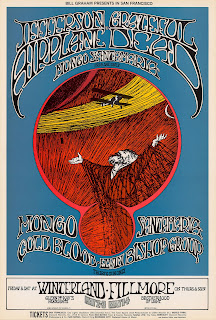
The Jefferson Airplane and Grateful Dead had played May 2 and 3, 1969 (Friday and Saturday) at Winterland, supported by Mongo Santamaria. Mongo, Cold Blood and Elvin Bishop were at Fillmore Thursday and Sunday

The Grateful Dead/Bill Graham Presents 1969

The Grateful Dead had been headlining concerts for Bill Graham Presents since October 1966 at the Fillmore. This status had continued when Graham moved to the Fillmore West in July 1968. These December 1969 shows were the fourth weekend in 1969 at which the Dead had headlined the Fillmore West. Grateful Dead performances for Bill Graham Presents were an evolving process, as always, but since both the Dead and Bill Graham established the future of the rock concert industry, any evolution in their arrangements had implications for the profession as a whole. Up until this December weekend, Grateful Dead shows at Fillmore West had followed the same pattern as the Fillmore Auditorium shows that had preceded them. 

At Fillmore and Fillmore West, there had always been three bands advertised ("On The Poster"), and they would both play two sets. In contrast to future years, however, the bands rotated throughout the night, so the headline band played the third and sixth set of the night. This allowed audiences to come and go. Suburban teenagers could come early, and city denizens who worked at restaurants and the like could come late, and all patrons could see all three bands. Some hardcore fans could stay throughout, but that was initially uncommon. Particularly in 1966-67, people went to the Fillmore (or the Avalon) because it was "The Fillmore," to see whoever happened to be booked. In many cases, the bands didn't even have records, or if they did, no radio station was playing them. Fans were just checking out the scene. If they were lucky, they caught the Grateful Dead or Quicksilver Messenger Service (or numerous other bands)  before they were known, laying down the future of rock music.

There were times that another act would be added to the bill, usually on Friday or Saturday night. Often they were bands who had played the Fillmore West Tuesday "audition nights," and recently discovered by the Bill Graham organization. These bands were rarely advertised, neither on "The Poster" nor even in daily newspaper listings. This peculiar practice explains bands who recall opening for famous groups at Fillmore West even though they were not "On The Poster." Such bands only played one set, so the headline act would play the 4th and 7th sets of the night.

The significance of the Grateful Dead's December, 1969 Fillmore West shows was that the venue evolved to a more conventional single set, evening-ending performance to conclude the show. The taped evidence suggests rather strongly that the Dead ended each night with a single extended set, rather than playing two shorter (45 minutes>one hour) sets at different points in the evening. Though unnoticed, this evolution brought the Grateful Dead into the mainstream of rock concert performers at the time. Due to the paucity of information about Fillmore West concerts in late 1969, I don't know whether the Dead were among the last or the first of performers who moved from two separated sets to one longer one.

Now, for every other promoter in 1969, whenever the Grateful Dead headlined a show, they came onstage and ended the show. In most cases, they played a single long set, plus an encore. It may be that in a few instances, the Grateful Dead played two sets--if they did that in 1969, the reason was likely equipment related--but the band still ended the show. The only times the Grateful Dead would turn the stage over was when they had two performances in the same evening. At Bill Graham's Fillmore East, for example, almost all shows (save for a few weeknight benefits) had an early and a late show, and the headliner and the opener played both shows. When the Grateful Dead had played Fillmore East with Country Joe and The Fish (and opener Sha-Na-Na), for example, on September 26-27, 1969 (Friday and Saturday), the Dead had played two sets separated by the other acts. From the point of view of the crowd, however, the bands would play single sets for each audience.

So when the Grateful Dead played single long sets at Fillmore West in December, 1969, they were stepping away from one of the factors that made the Fillmore West a unique rock performance venue. The configuration went from a nightclub-like booking, with multiple acts repeating their performances, to a concert setting, where each performer presented a single time.
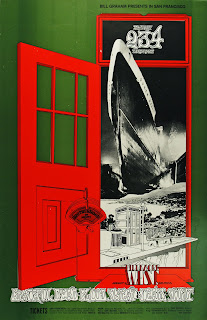

The Grateful Dead at Fillmore West, 1969

January 2-5, 1969 Fillmore West, San Francisco, CA: Grateful Dead/Blood, Sweat & Tears/Spirit (Thursday-Sunday)
The Grateful Dead had co-headlined New Year's Eve with Quicksilver Messenger Service, with an all-night (9pm-9am) extravaganza that included It's A Beautiful Day and Santana, then both rising bands. They followed New Year's Eve with another weekend, supported by Blood, Sweat & Tears, who would go on to become one of the biggest bands of the year (their album would sell 4 million copies). Little is known about the Dead's performances this weekend.

February 19, 1969 Fillmore West, San Francisco, CA: Grateful Dead/Golden Toad (Wednesday) "Celestial Synapse"
The Dead played a private event on February 19, 1969, but that was a Wednesday night for an invited crowd.


February 27-March 2, 1969 Fillmore West, San Francisco, CA: Grateful Dead/Pentangle/Sir Douglas Quintet
(Thursday-Sunday)
This four night stand at Fillmore West was perhaps the most seminal live weekend in Grateful Dead history. The band recorded most of what would become Live/Dead, on state-of-the-art 16-track Ampex recorders. The band would release a memorable 10-cd set of the entire weekend in 2005. Grateful Dead music really doesn't get any better than this.

And yet there was more. The opening act was the English group Pentangle, a unique English ensemble, with two (mostly) acoustic guitarists, a jazzy rhyhm section and a female singer. Jerry Garcia explicitly stated a decade later that hearing Pentangle made him consider the possibility of two amplified acoustic guitars over a rock rhythm section as a sonic possibility. It would take almost another year before the Dead broke out their acoustic format, but hearing Pentangle was the catalyst.

The Dead were playing the 3rd and 6th sets of the night (and on at least one night, when Shades Of Joy opened, the 4th and 7th set). One of the byproducts of this arrangement was that the headline act had to be "in the house" when the other bands where going through their second round, so musicians had little choice but to hear each other play. Thus Garcia heard Pentangle, and it had a profound influence on future Grateful Dead acoustic configurations.

May 2-3, 1969 Winterland, San Francisco, CA: Jefferson Airplane/Grateful Dead/Mongo Santamaria (Friday-Saturday)
In 1969, the Grateful Dead had also played two weekends for Bill Graham Presents at Winterland, twice the size of Fillmore West (officially 5400 vs 2500), both times in conjunction with the hugely popular Jefferson Airplane. These concert weekend were configured differently than the Fillmore West shows. After any opening acts, the Dead and then Jefferson Airplane would play a single extended set. None of the bands returned for a second set.  

Jefferson Airplane were hugely popular, but the rock scene had not expanded enough that they could sell out Winterland on their own. So the Airplane and the Dead played Friday and Saturday night at Winterland, with as many tickets on sale as if they had played four nights at Fillmore West. Latin jazzer Mongo Santamaria opened the show. He would have been great, but this was more a case of Graham showcasing music he wanted to be heard, as he was a Latin jazz fan.

May 28, 1969 Winterland, San Francisco, CA: Jefferson Airplane/Grateful Dead/Creedence Clearwater Revival/Santana/Elvin Bishop Group/Aum/Bangor Flying Circus (Wednesday) People's Park Bail Benefit
The Dead had also played a Benefit at Winterland on May 28, 1969, with many other acts. They had only played a brief set, however, and Rolling Stone's Michael Lydon complained that the Dead "didn't get it going.

June 5-8, 1969 Fillmore West, San Francisco, CA: Grateful Dead/Junior Walker and The All-Stars/Glass Family (Thursday-Sunday)
The Grateful Dead headlined over Junior Walker and The All-Stars, a popular group but not a huge draw. This weekend stands out because Garcia was late one night (early set June 6) and Bill Graham insisted that Wayne Ceballos of AUM stand in for him. As if that weren't enough, for the last set of Sunday night (June 8) some experimentation by Owsley left Garcia--shall we say--"unavailable,"--so Ceballos returned with Elvin Bishop to lead a 48-minute "Turn On Your Lovelight."


October 24-26, 1969 Winterland, San Francisco, CA: Jefferson Airplane/Grateful Dead/Sons Of Champlin/Doug Kershaw
(Friday-Sunday)
Jefferson Airplane were bigger than ever. They would release their sixth album on RCA, Volunteers, in early November. The album was probably already getting heavy airplay on KSAN and other FM stations by the time of the concert, and copies may have even been available in record stores. The Grateful Dead would also be releasing the classic album Live/Dead in early November. The Jefferson Airplane closed the shows on Friday and Sunday, but the Grateful Dead were the last act on Saturday night (October 25). Also on Sayturday, Stephen Stills and Graham Nash played a guest acoustic set, and Stills jammed with the Dead on "Lovelight."
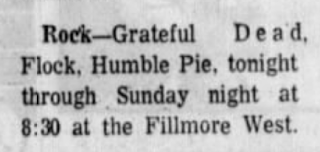
The SF Examiner listing for Fillmore West on December 4, 1969

December 4-7, 1969 Fillmore West, San Francisco, CA: Grateful Dead/The Flock/Humble Pie
(Thursday-Sunday)
Although the Grateful Dead's December Fillmore West shows conformed with rock concert orthodoxy by concluding with a single long set, there was still some elements that were distinctive to Graham and the venue. In the 60s, every rock concert was expected to have multiple acts. In most cases, the headline act was preceded by a local band. At the Fillmore West, the openers were bands on major labels with albums to their names. Now, it's true that San Francisco bands often opened Fillmore West shows, but they too were bands with albums on major labels.

By December, the Grateful Dead had released Live/Dead and had become established enough in the Bay Area that they did not need a major support act to sell tickets. There was still an assumption, however, that a proper rock concert at Fillmore West had three bands, and that the two openers were substantial bands, even if they were not yet popular. Many, many Bay Area rock fans were proud of having gone to the Fillmore or Fillmore West and heard bands on the way up, if only so they could brag a year later "yeah I saw Santana and Chicago open for Big Brother when no one knew who they were (e.g. September 12-14 '68)." The two opening acts in December hadn't sold a lot of records, but the musicians in the band had futures on tap. 


The Flock were a unique horn band from Chicago, and they had released their debut album on Columbia back in July. Now, rock bands with a horn section were hardly unique, particularly on Columbia. Blood, Sweat & Tears and Chicago Transit Authority had both signed with the label back in '68, and by late '69 both bands had sold a lot of records. Other labels were signing rock bands with embedded horn sections, too, like San Francisco's own Sons Of Champlin (Capitol), The Serfs (out of Kansas, also on Capitol) and the Keef Hartley Band (on Decca, out of London).

The Flock played jazzy rock with a touch of soul and a lot of solos, pretty much the same model as for Chicago or The Sons. The special aspect of The Flock was that the principal soloist was electric violinist Jerry Goodman. Goodman was also one of the lead singers, and the band didn't have a keyboard player. Goodman was a great player, and The Flock had a very distinctive sound. Still, the Flock didn't really have many memorable songs, whereas bands like Chicago or BS&T had endlessly hummable material, whether you liked it or not.

A little bit of live material from the Flock floats around, and they were at the very least an interesting opening act (for a live example from German TV in 1970, see here). Electric violin was still pretty exotic in 1969, particularly in the context of a horn section rather than countrified music. Jerry Goodman would go on to be well-recognized as a virtuoso when he would join the original Mahavishnu Orchestra in 1971 (Deadheads may recognize Goodman from the 90s jam-band Dixie Dregs). So The Flock would have made an impression as the Dead's opening act, even if in the end they didn't really make it big. At least alert fans could say a few years later that they had seen Goodman before Mahavishnu, and that is what a certain kind of mostly male rock fan lived for (I was exhibit A). 


Humble Pie, meanwhile, was a newly-formed band touted by the English rock press as a "supergroup." At the time, the Pie were all but completely unknown. Within a few years, however, Humble Pie would be Winterland (and National) headliners in their own right. Lead guitarist Peter Frampton would leave Humble Pie in late 1971 to go solo, leading to his legendary double-live album Frampton Comes Alive. After it was released in Summer '76, Frampton Comes Alive became the best-selling live album of all time (over 3 million copies sold). While its sales record has since been eclipsed (Eric Clapton's Unplugged shipped an astonishing 10 million units), Frampton Comes Alive triggered every touring rock band to release a live "Greatest Hits" style double album sometime during the 1970s. So Humble Pie turned out to be an important band, even though they were still struggling to get heard in the States back in December '69.

Humble Pie's anchors were guitarists Steve Marriott and Peter Frampton. Both were excellent singers, and handsome lads who had been "Teen Idols" in England, a frustrating experience they had both shared. Marriott had led the Small Faces, a hugely successful "Mod" band in the UK who had never made much of a splash in the States (their only US hit had been "Itchykoo Park"). Frampton had been in The Herd, not as monumental as Small Faces, but still with some hits to their name. When The Herd had broken up in late 1968, Marriott had wanted Frampton to join the Small Faces as lead guitarist. Bandmates Ian McLagan and Ronnie Lane rejected this suggestion, however. So Marriott and Frampton went off and formed Humble Pie (McLagan, Lane and drummer Kenny Jones, meanwhile, teamed up with Rod Stewart and Ronnie Wood to form Faces).

Marriott and Frampton added drummer Jerry Shirley and bassist Greg Ridley. Ridley had been in the underrated band Spooky Tooth, and he, too, was an excellent, soulful vocalist. With 3 strong singers and two striking guitarists, Humble Pie didn't lack for talent. In the fashion of the times, their July '69 debut album As Safe As Yesterday Is featured music that was in a rustic style that intentionally evoked Music From Big Pink. Humble Pie did not emphasize hard rock until the early 70s. The Pie were signed to Immediate Records, run by former Rolling Stones' manager Andrew Loog Oldham. 

At the time of the first American Humble Pie tour, Immediate was nearly bankrupt. Humble Pie's second album, the laid back Town And Country had been released in the UK, but not in the States. A few FM stations had the import, however, so Humble Pie was probably getting a little play on KSAN. Now, the Small Faces had not been big in the US, and no one would have known who The Herd were, and thus Humble Pie wouldn't have been seen as a "Supergroup." They were still a "New Thing" from England, however, and that was never nothing.

Humble Pie Live At The Whisky A-Go-Go '69, released by Castle in 2002

We actually have a pretty good idea of what Humble Pie must have sounded like in December '69, since in 2002 a Pie show was released from the Whisky A-Go-Go, recorded the very next week (on December 13-16, opening for Grand Funk Railroad). Whatever your subsequent view of hard-rocking Humble Pie, the 1969 variation had more of an R&B orientation and more pronounced movement from quiet to loud and back. They would open with a mostly-acoustic cover of the Yardbirds hit "For Your Love," followed by a mix of covers and originals. The album only has 5 tracks, but it's a good look at what the band likely sounded like at Fillmore West (for a great sample, see this 1970 German TV version of "The Sad Bag Of Shakey Jake" with all three vocalists in their prime). 


Humble Pie Live At Fillmore West December 1969

For many years, decades really, we didn't have any first-hand accounts of this weekend Fillmore West. Rather unexpectedly, a detailed description turned up in the memoir of Humble Pie drummer Jerry Shirley. Best Seat In The House: Drumming In The 70s with Marriott, Frampton and Humble Pie (2011; Rebeat Books) is a loving memoir of the Good Old Days when they were Bad. Of course, you have to like 60s and 70s rock in grimy detail, but that is pretty much what I live for, so I recommend it highly.

One interesting thing about Shirley's description of the Fillmore West was that he was no fan of the Grateful Dead. He has no grudge against them--he just dismisses them as being self-indulgent for playing too long. Shirley reports that Humble Pie came on in between The Flock and the Grateful Dead. I suspect this was a sign that Humble Pie was getting at least some airplay on KSAN. Shirley (chapter 8): 

The Fillmore West audiences were notoriously difficult to satisfy, and we soon found out why--they were so stoned that you could easily mistake the real culprit, barbiturates mixed with cheap red wine, for total lack of interest. The Ripples-and-reds crowd, as they were affectionately known, became our latest challenge. We were determined to leave our mark, and in this case the goal was simple: if we woke 'em up, we had scored. With this lot, the last thing in the world you wanted to do was knock 'em out!

Bill Graham ran this Fillmore with same military efficiency he was famous for at the Fillmore East...at the beginning of December, 1969, a lot was happening in America, both musically and socially. The Charles Manson murders had occurred only months earlier, and the Stones were getting ready to play a huge free concert at Altamont, that now-famous racetrack just outside San Francisco. There was talk that the size of the crowd would outdo Woodstock (although "only" about 300,000 attended, far fewer than Woodstock's "half a million strong"), and one of the main acts on the bill was to be the Grateful Dead. Nothing wrong there, except that they were also supposed to be headliners for our third show at the Fillmore West. We were set to play the middle spot after an American band called The Flock, who had started to make some headway in the charts and featured an electric violinist who was a show all of his own. Not my cup of tea, but interesting, I suppose.

The Dead ended up not playing at Altamont because of the violence there. The problem was that the security force they had hired for the show, the Hell's Angels, who saw fit to use stabbing as a form of crowd control. The Angels killed an innocent bystander while the Stones were playing, which caused more than a little set of problems...

The Grateful Dead couldn't get out of Altamont to be at the Fillmore West. So we ended up playing our third show at Fillmore West shows as headliners, as we were the only band that could get there. The same applied to the crowd: only a very few people actually made it from Altamont, and they were so exhausted that they got in, sat down in front of the stage, and went to sleep. We must have been really impressive that night, because we managed to wake them up.  

So there you have it, such as it is: no eyewitness accounts of the Dead performances on Thursday, Friday and Sunday, although we have some tape, but a detailed memory of the night that the Dead didn't play. 

Aftermath
After December 1969, the Grateful Dead did not cede the stage once they got on it. They would take breaks, or play all night, as the case might have been, but there was no more rotating around the bill. The Dead would co-headline on occasion for another few months, but once Workingman's Dead got out there, the Dead were headliners in their own right. There were occasional exceptions, like giant outdoor shows or benefits, but the Grateful Dead made themselves a hard act to follow.

The Flock put out one more album (Dinosaur Swamps) and faded away. The Flock opened for the Dead again in New Orleans, when they were busted down on Bourbon Street (January 31-February 1). Jerry Goodman went on to success with Mahavishnu Orchetra, Dixie Dregs and numerous other recordings. 

Humble Pie toured successfully until 1975, even after Peter Frampton left. They had moved to A&M Records in 1970, toured hard and made themselves into a great concert attraction. Frampton left in late '71, to great success, but the Pie continued to rise in popularity. It all ground to a halt, however, and there were many financial issues with management. Steve Marriott, hugely talented and much beloved by his peers, nearly had a reunion with Peter Frampton and a reformed Humble Pie in 1991. The project was put on hold, however, and Marriott died in a fire in 1991, deeply mourned by the public and his friends.


Friday, January 28, 2022

Halloween Weekend 1969: Loma Prieta Room, San Jose State and Family Dog on The Great Highway (Oct 31-Nov 2 '69) [FDGH V]


The Grateful Dead: Halloween Weekend, October 31-November 2, 1969
Over the years, it seemed like a Law Of Nature (or a Federal statute) that the Grateful Dead had to play on Halloween. Skeleton iconography attracts skeleton iconography, and a Dead concert on Halloween always seemed like a good idea. 

A close look at Halloween 1969 poses a paradox for the band. They were booked for the weekend at the Family Dog on The Great Highway, where they could draw 1500 or 2000 fans each night at $3.50 a head. Yet they only played the Dog on Saturday and Sunday, leaving the actual Friday night of Halloween for a campus event at San Jose State College. The newly-opened Student Union Ballroom held, at most, 700 people. Even if it was oversold, since student admission was only $2.00, the payday wasn't going to be the same as at the Dog.

What were the Grateful Dead and their management thinking? This post will take a look at the different threads in play for the Grateful Dead over the weekend of October 31-November 2, 1969.


Grateful Dead Economic Status Report, Fall 1969

In late 1969, the Grateful Dead were hurting for cash. They had spent so much money on Aoxomoxoa that they weren't earning anything back on royalties. Live/Dead would be a kind of success, but it wouldn't be released until November, so royalties wouldn't show up until later. The Dead, being the Dead, of course, were always spending too much money on equipment, and keeping a lot of friends and girlfriends on the payroll. This took cash, and the Dead didn't make that much.

Of course, the Dead's cash flow problem was greatly aggravated by the fact that manager Lenny Hart was absconding with a significant amount of the band's money. Hart's management "strategy" was dubious, at best, and in hindsight some of it may have been oriented towards bookings that facilitated Hart's greedy fingers, rather than the band's best interests.

The Family Dog on The Great Highway had a capacity of something around 1500 (the Fire Department capacity may have been a bit lower). Some contemporary comments in the Examiner suggest that a full house at the Dog approached 2000. Whether that meant they oversold the house, or people came and went throughout the night, it gives us an idea that the gate was about $6500 per night (assuming paid attendance of about 1850). Assuming costs for expenses, opening acts and profits, figure that the Dead could clear $4000 on a great night. 

The Student Union Ballroom at San Jose State held, at most, 700 patrons. Students would only pay $2.00, and they would have been the bulk of the audience. So even assuming a little bit of overselling and a few non-student admissions (at $3.00), and the possibility that a lot of students might come and go throughout the evening (allowing for more ticket sales), the realistic gate would be around $2000. The catch here was that San Jose State would have had an entertainment budget, and that ticket sales were meant to only defray the cost, not cover it. It's reasonable to assume that the Dead would have cleared $2500 or even $3000 for the Friday night show, which was still less than the Dog.

The difference in the two bookings was that San Jose State, though likely cheaper, was a sure thing. San Jose State was not going to go out of business. The Family Dog on the Great Highway, conversely, was always in a precarious financial situation. A band who booked a future show at the Dog had no guarantee the venue would be in business by that time. On top of that, rock concerts, like any live entertainment venture, were inherently risky ventures. The Grateful Dead, by what little evidence we have, had drawn well when they had played at the Family Dog for two weekends in August, and there was every reason to think they would do so again. 

There was one hangup, however: the Family Dog wouldn't be able to advertise the Dead show until that very week. Bill Graham Presents had booked the Dead with Jefferson Airplane for the prior weekend, and the contract would have required that the Dead could not advertise a show within 50 miles until their booking was complete. Now, it wasn't that Dead fans wouldn't want to see the band again--that was never a problem. It's just that concert attendance takes planning, and if you don't know there's a Dead concert on Halloween weekend, what if you've got something else going on? What if your sister already got the family car and you've got no way to get there?

Also, on any given night, anything could happen--rainstorm, earthquake, fire in the venue, riots in the neighborhood--that would lead to a financial debacle at the Dog. This risk was magnified by the prohibition on advertising until the previous Monday. Now, sure, the same things could happen at San Jose State. My guess, however, was that some part of the San Jose State concert booking was guaranteed, and that would be paid regardless, and very possibly paid in advance. The Dead were hurting for cash, and Lenny Hart was hungry for it, so a smaller, ensured payday on Halloween took precedence over a potentially larger one at the more uncertain Family Dog. So the Dog had a ghost of a show on Halloween without the Dead, and the Dead turned up for the balance of the weekend. Although non-musical details are scant, it seems that the Dead did well both nights at the Dog, so it was a financially sound weekend in the end.


Loma Prieta Room, Student Union, San Jose State University, 211 S 9th St San Jose, CA 95112
San Jose State College (now Cal State San Jose University) was the oldest college in California, first established as a Teacher's College in 1857. After various name changes, it became San Jose State College in 1935. After World War 2, thanks to the GI Bill and the Baby Boom, San Jose State expanded enormously. By 1969, it probably had 15,000 students or more (currently it has over 33,000, with 3/4 of them as undergraduates). The school is right at the center of downtown San Jose, which itself was expanding in the 1960s. The Student Union building at 211 9th Street had just been built in 1969. The main ballroom was on the third floor, and depending on the configuration, was either called the Ron Barrett Ballroom (capacity 588) or the Loma Prieta Room (capacity 700). The new ballroom had only opened on Tuesday, October 13, 1969. The very first rock concert at the Student Union Ballroom was held on the first Friday it was open. On October 17th, the New Riders of The Purple Sage played with a jazz-rock band called The Fourth Way.


The Daily Spartan of Thursday, October 16 reported on the upcoming dance the next night at the Student Union Ballroom

Two Bands To Appear For Dance
"Riders of the Purple Sage with special guest appearances by Jerry Garcia and Mickey Hart of the "Grateful Dead" will be one of the two bands playing tomorrow night in the new College Union on Ninth Street
A dance sponsored by the College Union Program Board will feature "Sage" and "The Fourth Way," with guest appearances by members of the Charles Lloyd Quartet and John Handy's group.
The dance will be held from 9 pm to 1 am in The BALLROOM on the third level of the College Union. Admission will be $1.50 for students and $2 for the general public. There will be no pre-sale; all tickets will be sold at the door.
By October 17th, the Grateful Dead would have already booked their Halloween show at the same venue. In this instance, besides booking a paying gig for the New Riders, it seems like the Dead were checking out the venue in advance. It was a very odd feature for the New Riders to headline a venue on a Friday night, and then for the Dead the same venue two weeks later. This suggests to me that the Dead booked the Halloween show, and then realized they could book another show two weeks earlier. 

The Fourth Way was an interesting electric jazz-rock band. There were a lot of bands in the Bay Area fusing rock, jazz and electricity, but Fourth Way did it in a less frantic style than Miles Davis or the Tony Williams Lifetime. Fourth Way did release three albums on Capitol, now long out-of-print. Bandleader Mike Nock, formerly pianist with Yusef Lateer, Steve Marcus and many others played electric keyboards. The lead soloist was electric violinist Mike White, best known for playing with the John Handy Quintet. Bassist Ron McClure had played with Handy, and then with a Charles Lloyd Quartet lineup when it was based in San Francisco (along with Keith Jarrett and Jack DeJohnette). Drummer Eddie Marshall rounded out the quartet.

We don't know what happened at this show. Was it well attended? Who knows? In the peculiar way of Dead history, however, while we don't have an eyewitness account, we have a tape. The Owsley Foundation was kind enough to transcribe the setlist for us. We can see that Bob Weir showed up for a few numbers, so there was a taste of Bobby Ace and The Cards Off The Bottom Of The Deck.
    Crossover
    Hello Trouble
    Long Black Limousine
    Six Days on the Road
    Next In Line
    Games People Play
    To Have the Hurting End
    Whatcha Gonna Do
    The Race Is On (w/Bob Weir)
    Cathy's Clown (w/Bob Weir)
    Saw Mill (w/Bob Weir)
    Mama Tried (w/Bob Weir)
    Me & My Uncle (w/Bob Weir)
    Fair Chance to Know

In any case, Owsley and the crew probably had a chance to figure a few things out about the room setup, and that had to help for Halloween.

October 31, 1969 Loma Prieta Room, San Jose State College, San Jose, CA: Grateful Dead/South Bay Experimental Flash (Friday)
We know the Grateful Dead played the Student Union Ballroom on Halloween, because we have a tape. It's around 90 minutes, and my guess is that it's the entire Grateful Dead performance.  We don't really know anything about the show itself.

There were two articles previewing the event in The Spartan Daily

GRATEFUL DEAD BRING LIVE MUSIC TO LIVELY SJS HALLOWEEN FLING

This Friday evening SJS is having its own “trick-or-treat,” when it brings out The Grateful Dead to play in the College Union Ballroom.
 
The Grateful Dead, pioneers of the San Francisco sound, will be making their first appearance at SJS Halloween night.
“The Dead” have added a little country to their blues and psychedelic elements, and the blend works well, according to people who saw them last weekend at Winterland.
“The Dead,” whose music has what many people term a euphoric effect, will play two sets, a total of one and a half to two hours. It is hoped that they will play some of their more famous sets which range from straight country, as in “Mama Tried,” to the blues encore, “Good Morning Little School Girl.” In the former, bass guitarist Phil Lesch produces a good country vocal sound, and in the latter, Ron (Pig Pen) McKernan is at his vocal best. 
Lead guitarist Jerry Garcia also has a good set as does organist Tom Constante and rhythm guitarist Bob Weir. The dependable work of drummers William Kreutzman and Mickey Hart is ideal in the country tunes. 
Accompanying “The Dead” will be the far out sounds of the “Experimental Flash.” In addition, two color horror films will be shown, “Billy the Kid vs. Dracula” and “Godzilla vs. The Thing.” Both films will be shown silently behind the bands. 
The dance will be held from 9 p.m. to 1 a.m. and admission is $2 for students and $3 for the public. Tickets are on sale in [the] Student Affairs Business Office, located on the second level of the College Union.

(by Marty Pastula, from the Spartan Daily, San Jose State College, 29 October 1969)
BANDS TO PLAY AT MASKED BALL IN COLLEGE UNION

The Grateful Dead and Southbay Experimental Flash will perform at 9 p.m. tonight in the College Union to a masked audience.
In keeping with the theme of Halloween, the College Union Program Board (which is sponsoring the dance) has asked that all those attending tonight’s dance wear masks.
It is hoped that the debut of The Grateful Dead at SJS will be a pace-setter for future “name groups,” according to [the] CUPB student director.
The CUPB will provide masks for those who “forget their disguises.”
Tickets are still available in the Student Affairs Business office. [...]
[The] CUPB director added that in case it gets too warm, there will be “bobbing for apples” as refreshing but perhaps “ghostly” fun.

(from the Spartan Daily, 31 October 1969)

Setlist
Casey Jones, Dire Wolf, It Hurts Me Too, Cryptical Envelopment-> Drums-> The Other One-> Cryptical Envelopment, China Cat Sunflower-> I Know You Rider, Mama Tried, High Time, Sitting On Top Of The World, Next Time You See Me-> Easy Wind, Turn On Your Love Light

South Bay Experimental Flash
The South Bay Experimental Flash were a jazz-rock quintet from San Jose, although by 1969 they actually lived in Richmond. The main soloist was flautist David Ladd, well known over later decades in the South Bay as a session man and music teacher, along with organist Harry Critchfield and drummer Kirk Harwood.

The Poster
There is a relatively well-known poster associated with the San Jose Halloween concert (at the top of the post). I am no poster expert, by any means, but it does raise a few questions:
  • Why was there a poster? This was a student show, subsidized by the college, and not intended to turn a profit. Why authorize a color poster, since it's a needless expense?
  • I can understand some hippies on the "Entertainment Committee" who wanted to commission a poster because it was cool. But why print it? Why print hundreds of copies at real cost? For one thing, even by 1969, any Fillmore or Fillmore-type poster accessible on a telephone pole was immediately removed and put up in someone's dorm room. So posters were not only a cost, they didn't help sell tickets.
  • I can see one poster for display outside the Student Union ticket office. But why print more? Do they circulate? Some part of this doesn't add up, although it may be that the posters were reprinted later because they were appealing.

Loma Prieta Room: Aftermath
The brave comment in the Spartan Daily about the Grateful Dead being the "pace-setter" for future name groups at the Loma Prieta Room turned out to be outrun by events. There were some more rock concerts at the Loma Prieta Room in Fall '69, the biggest name of which was Lee Michaels. Rapidly, however, the rock business got way bigger than any tiny 700-seat room on a campus, so while I'm sure there were occasional events, the Grateful Dead were far and away the biggest band ever to play the Student Union Ballroom.

The Loma Prieta Room was remodeled, and thus while the building is still in use, the Ballroom is not the same as when the Dead played there. During November 5-8, 2014, Cal State San Jose University held So Many Roads : The World in the Grateful Dead, A Conference & Symposium  in the Student Union building (though not the Loma Prieta Room, then under re-construction).

The Family Dog on The Great Highway, at 660 Great Highway, ca. 1969

The Family Dog on The Great Highway, 660 Great Highway, San Francisco, CA
The Family Dog was a foundation stone in the rise of San Francisco rock, and it was in operation in various forms from Fall 1965 through the Summer of 1970. For sound historical reasons, most of the focus on the Family Dog has been on the original 4-person collective who organized the first San Francisco Dance Concerts in late 1965, and on their successor Chet Helms. Helms took over the Family Dog in early 1966, and after a brief partnership with Bill Graham at the Fillmore, promoted memorable concerts at the Avalon Ballroom from Spring 1966 through December 1968. The posters, music and foggy memories of the Avalon are what made the Family Dog a legendary 60s rock icon.

In the Summer of 1969, however, with San Francisco as one of the fulcrums of the rock music explosion, Chet Helms opened another venue. The Family Dog on The Great Highway, at 660 Great Highway, on the Western edge of San Francisco, was only open for 14 months and was not a success.

One of the only photos of the interior of the Family Dog on The Great Highway (from a Stephen Gaskin "Monday Night Class" ca. October 1969)

The Great Highway was a four-lane road that ran along the Western edge of San Francisco, right next to Ocean Beach. Downtown San Francisco faced the Bay, but beyond Golden Gate Park was the Pacific Ocean. The aptly named Ocean Beach is dramatic and beautiful, but it is mostly windy and foggy. Much of the West Coast of San Francisco is not even a beach, but rocky cliffs. There are no roads in San Francisco West of the Great Highway, so "660 Great Highway" was ample for directions (for reference, it is near the intersection of Balboa Street and 48th Avenue). The tag-line "Edge Of The Western World" was not an exaggeration, at least in American terms.

The Family Dog on The Great Highway was smaller than the Bill Graham's old Fillmore Auditorium. It could hold up to 1500, but the official capacity was probably closer to 1000. Unlike the comparatively centrally located Fillmore West, the FDGH was far from downtown, far from the Peninsula suburbs, and not particularly easy to get to from the freeway. For East Bay or Marin residents, the Great Highway was a formidable trip. The little ballroom was very appealing, but if you didn't live way out in the Avenues, you had to drive. As a result, FDGH didn't get a huge number of casual drop-ins, and that didn't help its fortunes. Most of the locals referred to the venue as "Playland." 

October 31, 1969 Family Dog on The Great Highway, San Francisco, CA: Danny Cox/Alan Watts/Golden Toad/Hells Angels Own Band (Friday)
The Family Dog had opened to great fanfare on June 13, 1969, but since then it had lurched through October with little to show for it. The venue had been open almost every night of the month, mostly with a variety of community-oriented events that only charged $1.00 admission on weeknights. While in retrospect we can see that some of the weekend acts would have been playing some good music (Kaleidoscope or Brewer And Shipley, for example), they weren't really good draws. The Dead were taking the sure payday in San Jose on Halloween, but they would be back at the Family Dog on Saturday and Sunday (November 1 and 2).

So for Halloween at the Family Dog, the putative headliner was the Golden Toad and folksinger Danny Cox, both of whom would be opening for the Dead on the subsequent nights. The unexplained billing was "Hells Angels Own Band." Who were they? What did it mean? We kind of know it wasn't the Dead, since they were playing in San Jose. I guess you could claim they were going to show up late, but geography doesn't favor that, and in any case, why invoke the Hells Angels? I wouldn't go to any public event today that advertised anything to do with the Hells Angels, and this was Halloween 1969. Also, the Hells Angels never took kindly to anyone using their name satirically, so the usage must have had some kind of informal approval. 

Was this a biker party? Maybe--but why advertise it to the public? Also, bikers are bikers--were they going to look forward to a Renaissance Fair quintet playing 15th century melodies on hand-built replicas of medieval pipes (which is what Golden Toad did)? Sure, Golden Toad founder Bob Thomas was a personal friend (and sometime roommate) of Owsley, but would a bunch of cranked-up bikers care? Danny Cox was an enjoyable folksinger, but he was a big African-American guy, and the Hells Angels were never an advertisement for diverse inclusion. 

Nothing about the Friday night booking made any sense. I have one tiny clue: I had a clever, but inaccurate, theory that Owsley Stanley had made a tape of Danny Cox that would become the album Danny Cox Live At The Family Dog. The Owsley Stanley Foundation looked into it, and it turned out that Cox's manager would not let Owsley tape his act. Family Dog soundman Lee Brenkman thinks that Cox was recorded on Halloween. Brenkman referred to the event as the "Hell's Angels Halloween party", and added that "it was the last calm thing that occurred that night." Intriguing. Anyone with insight, rumors or clever speculation, please post in the Comments.

November 1-2, 1969 Family Dog on The Great Highway, San Francisco, CA: Grateful Dead/Danny Cox/Golden Toad (Saturday-Sunday)
The Grateful Dead headlined the Family Dog on The Great Highway on Saturday and Sunday night. Thanks to Owsley Stanley, we have tapes of both nights. The playing on both nights is magical. The existing tapes are both two hours, and seem to be complete shows with a few minor snips. So Golden Toad and Danny Cox must have each done sets, capped by a two-hour blast by the Grateful Dead in their early prime. David Browne, in his great Dead reflection,  So Many Roads, reviews the November 2 (Sunday) tape, with its 30-minute "Dark Star" in its larger context, and it is well worth reading (as is the rest of the book). Whatever the commercial flaws of the Family Dog on The Great Highway, and they seemed to be many, the Dead played fabulously there. In early 1970, manager Lenny Hart would make plans to merge the Grateful Dead's operations with Chet Helms and the Dog, and it had to be at least in part because the band played so well in the room.

The Golden Toad had nothing to do with rock, of course. But they resolutely followed their own musical course, in a manner clearly aligned with the Grateful Dead's own single-minded mission. The Toad mostly played outdoors in at Renaissance Fairs (in Los Angeles and Marin) or in Berkeley, and usually only played indoors at Berkeley's Freight and Salvage or with the Grateful Dead. The Golden Toad were known to have a rather flexible membership, so they may have had numerous people on stage augmenting the root quintet (supposedly they had performed with up to 23 members) [see here for more about the Golden Toad].

Danny Cox's 3rd album was Birth Announcement, a double-LP released on Together Records in 1969 and produced by Gary Usher

Danny Cox was from Cincinnati, but he had relocated to Kansas City in 1967. Cox, a large African-American man, defied rather shallow 60s expectations by singing folk music instead of blues. His current album was his 3rd, Birth Announcement, a double-lp on Together Records produced by Gary Usher. Cox sang folk classics along with Beatles and Dylan songs, lightly backed.

Cox shared management with Brewer And Shipley, and like them he would record an album for ABC/Dunhill in San Francisco with producer Nick Gravenites. Recorded at Wally Heider Studios, it was released in 1971. Both John Kahn and Merl Saunders played on that album. During demo sessions for the record in 1970, Kahn introduced Merl Saunders to Jerry Garcia, who was recording in another room. Some weeks later, when Howard Wales didn't want to come jam at the Matrix, Kahn recommended Merl and the Garcia/Saunders partnership began.


In between 1969 Birth Announcement and his 1971 ABC/Dunhill albums, Sunflower Records released a 1970 Danny Cox album called Live At The Family Dog. Sunflower, associated with MGM, was a fringe label that had released the legal-but-unauthorized Vintage Dead and Historic Dead albums in 1971. Danny Cox only played the Family Dog this weekend and the next weekend in 1969, so assuming that the material was really recorded at the Family Dog--that's no sure thing--they could very well have been recorded this weekend. I speculated that Owsley might have recorded the tape, but it turned out not to be the case. Cox's manager, Howard Wolf, wouldn't allow Owsley to tape his act. As mentioned, soundman Lee Brenkman thinks that Cox was recorded on Halloween. (Scholarly readers will be interested to know that on the Family Dog lp, Cox records "Me And My Uncle," and it is credited to "Trad.--arranged Danny Cox.") 

Summary

  • The Grateful Dead played a tiny ballroom for 700 or so people on a college campus on Halloween Friday in 1969.
  • What went down on Halloween '69 at the Family Dog? Why book a Renaissance Fair pipe band and a folksinger and advertise Hells Angels Own Band? What was that?
  • The Grateful Dead played Saturday and Sunday night at the Family Dog. They played great music, and ticket sales were probably pretty good, because they usually were.
  • Opening act Danny Cox may have had his Halloween show recorded and released on Sunflower Records as Live At The Family Dog

Friday, November 26, 2021

September 6, 1969 Family Dog on The Great Highway, San Francisco, CA: Jefferson Airplane/Grateful Dead (What Do We Know?) [FDGH IV]


This cryptical listing in the underground paper San Francisco Good Times, from Thursday, September 5, 1969, was the only published hint that the Grateful Dead and the Jefferson Airplane would play the Family Dog on The Great Highway during the weekend. It was probably announced on FM radio

On Saturday, September 6, 1969 the Family Dog had what must have been its biggest show in its history. We know it was good, too, because we have the tapes. It was very likely packed. The Jefferson Airplane, one of the biggest drawing acts in rock music at the time, played the Great Highway, supported by no less than their old pals the Grateful Dead. Yet there was only the faintest hint of pre-show publicity, and not a word about it afterwards. If the Airplane and the Dead had played an unscheduled show at the Fillmore West, you can bet that Bill Graham would have made sure everyone heard about it, so every rock fan knew that the Fillmore was Where It Was At. The Family Dog let this event slip by without a trace--if Owsley Stanley had not taped both acts, we would never have any idea that the show had even happened.

After a packed opening night with the Jefferson Airplane, back on June 13, the Family Dog had since found itself in difficult financial straits. The venue itself was very appealing. The bands that had played the Family Dog each weekend, by and large, had been really good bands. The groups weren't quite as high profile as the Fillmore West, and Bill Graham always got the first bite of any band on tour. But the quality of music at the Dog was high. The location, far from the center of the city and not near an easy freeway exit, made the venue difficult to find for suburban teens. In the era before MapQuest, simple directions made a big difference. The problem seems to have been that not enough Bay Area rock fans had made it a habit to check out who might be playing at the Family Dog, and consider it as an option. For rock fans, checking to see who was at Fillmore West was automatic, whether or not you ended up going.  But the Family Dog hadn't yet gotten into the minds of Bay Area rock concert fans.

August 1969 had a run of really good bands at the Family Dog, including the Dead on two separate weekends (August 2-3 and 28-30), Country Joe and The Fish (August 8-10), Mike Bloomfield (August 15-16) and a slew of bands on the Wild West "makeup" shows (August 22-24). If there was any time that rock fans were noticing the Dog, it would have been this month. In retrospect, however, we can see August 1969 as a high water mark for the Family Dog. Come September, things would fall apart for the balance of the year. Probably no week in the Family Dog's 14-month history sums up its contrarian history so well as the first week of September. 

Let's review the week of September 1-7, 1969 at the Family Dog on The Great Highway.

The Family Dog on The Great Highway, at 660 Great Highway, ca. 1969

The Family Dog on The Great Highway, 660 Great Highway, San Francisco, CA
The Family Dog was a foundation stone in the rise of San Francisco rock, and it was in operation in various forms from Fall 1965 through the Summer of 1970. For sound historical reasons, most of the focus on the Family Dog has been on the original 4-person collective who organized the first San Francisco Dance Concerts in late 1965, and on their successor Chet Helms. Helms took over the Family Dog in early 1966, and after a brief partnership with Bill Graham at the Fillmore, promoted memorable concerts at the Avalon Ballroom from Spring 1966 through December 1968. The posters, music and foggy memories of the Avalon are what made the Family Dog a legendary 60s rock icon.

In the Summer of 1969, however, with San Francisco as one of the fulcrums of the rock music explosion, Chet Helms opened another venue. The Family Dog on The Great Highway, at 660 Great Highway, on the Western edge of San Francisco, was only open for 14 months and was not a success. Yet numerous interesting bands played there, and remarkable events took place, and they are only documented in a scattered form.


One of the only photos of the interior of the Family Dog on The Great Highway (from a Stephen Gaskin "Monday Night Class" ca. October 1969)

The Family Dog On The Great Highway
The Great Highway was a four-lane road that ran along the Western edge of San Francisco, right next to Ocean Beach. Downtown San Francisco faced the Bay, but beyond Golden Gate Park was the Pacific Ocean. The aptly named Ocean Beach is dramatic and beautiful, but it is mostly windy and foggy. Much of the West Coast of San Francisco is not even a beach, but rocky cliffs. There are no roads in San Francisco West of the Great Highway, so "660 Great Highway" was ample for directions (for reference, it is near the intersection of Balboa Street and 48th Avenue). The tag-line "Edge Of The Western World" was not an exaggeration, at least in American terms.

The Family Dog on The Great Highway was smaller than the Bill Graham's old Fillmore Auditorium. It could hold up to 1500, but the official capacity was probably closer to 1000. Unlike the comparatively centrally located Fillmore West, the FDGH was far from downtown, far from the Peninsula suburbs, and not particularly easy to get to from the freeway. For East Bay or Marin residents, the Great Highway was a formidable trip. The little ballroom was very appealing, but if you didn't live way out in the Avenues, you had to drive. As a result, FDGH didn't get a huge number of casual drop-ins, and that didn't help its fortunes. Most of the locals referred to the venue as "Playland."

The Grateful Dead were one of the few bands to consistently draw an audience to the Great Highway. While the Dead were not yet the irresistible attraction they would become in future decades, they had their own audience. The Dead's Bay Area audience--not yet even called Dead Heads--would make an effort to see them wherever they were. In contrast to most other bands, the more the Dead played the more fans wanted to see them, so there wasn't a concern about oversaturating their market with too many gigs. The distance and difficulty of getting to the Great Highway was not an impossible barrier, and the Dead shows seem to have drawn pretty well.

The Dead had played the weekend of August 2-3, and then returned on the weekend of August 29-30. On Thursday, August 28, the Dead had played an unannounced show that included a jam set with members of the Dead and Howard Wales. We only know of that show because Owsley taped it. Presumably it was mentioned on the radio on the day of the show, but if not for Owsley, the event would have slipped entirely under history's radar. The Dead would return the next weekend, sharing the room with the Jefferson Airplane. Save for Owsley, there seems to be no markers of this event. Rock venues, like all entertainment venues, depend as much on their reputation as a happening place as much as the events themselves. The Family Dog somehow failed to capitalize on their own underground cool.

The August 28 ad for the Family Dog on The Great Highway, promoting the Grateful Dead on the weekend of August 29-30, also included coming attractions for the week

September 1, 1969 Family Dog on The Great Highway, San Francisco, CA: Monday Night class

Like any venue, the Family Dog was willing to rent the hall out during the week when there wasn't a booking. Bill Graham did the same at Fillmore West. Besides clearing a little cash, and providing workdays for a few staff members, these sort of events could remind patrons that the Family Dog was a happening concern, worth checking out. The Family Dog had an additional goal, which was making itself into a community nexus, rather than being exclusively a venue for high-profile rock bands. Yet the Dog was seemingly unable to convert their community efforts into enticing a paying audience on weekends.

Stephen Gaskin was a popular literature instructor at San Francisco State, whose campus was not too far down the road (at 19th Avenue and Holloway). Gaskin spoke about what we would now be called "Human Consciousness" or "Self-Help," but at the time he was called a "Hip Guru." I am no expert in this area, but I will say that Gaskin was neither a con artist nor interested in turning a profit, rare for those sort. His "Monday Night" class had been running since at least July. I don't know whether it was every Monday night or just some, but it was popular (the interior picture of the Dog, just above, is from one of his Monday night events). Admission was free, and Gaskin just lectured, although I think they took donations. 

You would think that Chet Helms would have found a way to entice San Francisco State students that were interested in Self-Actualization on Labor Day Monday to consider checking out rock shows on the weekend. On this weekend, however, the upcoming show was a secret, so the crowd would not have seen a poster at the door encouraging them to check out the weekend rock show. An opportunity lost.

September 2, 1969 Family Dog on The Great Highway, San Francisco, CA: Theatre of The Absurd Costume Ball (Tuesday)
Other than the listing (above) on the Family Dog flyer, I have no idea about this event. It does seem clear that various theater and dance groups took advantage of the Family Dog space for various events, but I don't have any sense that the Dog was able to capitalize on it in any way.

September 3, 1969 Family Dog on The Great Highway, San Francisco, CA: Latin Night (Wednesday)
There had been a substantial Latin Jazz scene in San Francisco in the 1950s and '60s. Indeed, San Mateo's Cal Tjader had been an essential founder in the genre. Once Broadway in North Beach went topless, however, Latin Jazz went into decline in the city. Still, there was an existing scene, probably focused on "older" (although still under 40) fans. I doubt there would have been much synergy between the Latin Jazz crowd and the weekend psychedelic Dog shows, although renting out the venue for a night was still a good thing for the bottom line.

An ad from the Thursday, September 4 SF Examiner promotes the Carnival Ball and coronation of "Playland Girl '69"

September 4, 1969 Family Dog on The Great Highway, San Francisco, CA: Carnival Coronation Ball for Miss Playland 1969 w/Devil's Kitchen/Flying Circus (Thursday)
Playland-At-The-Beach was an amusement park, if an out-of-date one, and the Sunset District in those days was basically a suburb. So it's no surprise to find out that Playland apparently had an annual Beauty Pageant. It had probably run throughout the Summer. It is a telling irony that I am able to discern far more information about a weeknight local Beauty Pageant at Playland than any of the rock concerts by bands who remain popular decades after they were performing.

Devil's Kitchen were a band from Carbondale, IL, that had relocated to the Bay Area and became a sort of "house band" at the Family Dog. Brett Champlin (a distant cousin of Bill) played keyboards and sang, Robbie Stokes played guitar, Bob Laughton was on bass and Steve Sweigart was on drums. They played bluesy rock and roll. According to Brett Champlin, Devil's Kitchen were just another dance band at this show, providing music after the pageant was complete. The Metropolitan Sound Company was a soul band from Oakland, playing original soul music with a Hendrix touch, and the bands probably would have alternated. While the ticket rather enticingly says "Dress Optional," I take that to mean that guests were not obligated to dress formally, rather than at all. 

Based on the Examiner ad (above), it seems that Metropolitan Sound Co was replaced by the Mill Valley band Flying Circus. Flying Circus had existed since 1966, albeit with many personnel changes, and currently featured lead guitarist Bob McFee. He was the brother of Clover lead guitarist John McFee (many years later in the Doobie Brothers and Southern Pacific), and the two bands shared equipment and a rehearsal hall. As far as I can tell, Flying Circus played the kind of funky country rock typical of future Marin County bands. Brett Champlin only vaguely recalled the event, since he still had the complimentary ticket, so it was probably just another night for a working band. 

The SF Chronicle of Friday, September 6, 1969 reported Judith Vacek's election as Miss Playland '69

Given the paucity of information about rock shows at the Family Dog, it's notable that not only was there an ad in the Examiner for the Coronation Ball, we even know who won. The Friday SF Chronicle reported:
Judith Vacek shoots a good game of pool, measures a classic 36-26-36 and is "Playland Girl '69."
The 20-year old Tiburon girl was officially crowned as the Queen Of Playland At The Beach Thursday. The contest was conducted all summer and decided by popular vote of the public.
Miss Vacek, who aspires to be an airline stewardess, received a 1970 Ford Maverick that went along with her new title.

So, Judith Vacek won a Ford Maverick, was a babe, and shot a good game of pool. Wherever she is today, I hope that the Maverick served her well, that she had a nice life, and that she kept her pool game sharp. Yet the Jefferson Airplane and the Grateful Dead played the Family Dog over the weekend, and we only know about Judith. 

Let's set our modern hats aside and think about the Miss Playland Coronation Ball from 1969. It was some sort of "election." Apparently the different contestants invited their family and friends to submit votes and then come and cheer and vote for them. Now, let's be real here--what was rock and roll about in 1969 (and probably every other year)? Did all of the Miss Playland contestants get free tickets to the Family Dog? If not, why not? If you were a teenage boy rock and roller in 1969--long haired or not--and knew that beauty pageant contestants might be showing up at the venue on Friday night, wouldn't you be there? More importantly, wouldn't the venue want to shout to the newspapers that all the contestants (and their sisters!) were given free tickets all weekend? Now, maybe they did get free tickets--Judith Vacek could have driven her friends in her new Maverick--but the whole point would have been to publicize it. Yet somehow the Family Dog missed this equation.

September 5, 1969 Family Dog on The Great Highway, San Francisco, CA: Malachi/Rubber Duck (mime) and a jam with members of 3 groups we're not allowed to name
We only have the faintest hint of what might have happened on Friday night. The San Francisco Good Times had a cryptical ad (above). Malachi was a sort of moody guitarist, and Rubber Duck was a mime (Joe McCord) working with a rock band playing improvised music. But that wasn't the appealing part (well, unless you thought Beauty Pageant contestants would be there). The ad said, temptingly, "a jam with members of 3 groups that we're not allowed to name." 

Literally, we know nothing else about Friday night--not even if it happened.


September 6, 1969 Family Dog on The Great Highway, San Francisco, CA: Jefferson Airplane/Grateful Dead
(Saturday)
We have two great tapes from Saturday, September 6: one by the Jefferson Airplane, and one by the Grateful Dead. Notwithstanding that they were both recorded by Owsley Stanley himself, famous for (among many other things) accurate dating on tape boxes, internal evidence fits as well. At the end of the Grateful Dead tape, Jerry Garcia says "coming up next, Jefferson Airplane." At the end of the Airplane tape, Garcia jams with the Airplane. So it looks pretty definitive: whatever else happened on the weekend, the Grateful Dead and the Jefferson Airplane played the Family Dog on the Great Highway on Saturday night.

So why do we know nothing? It's understandable that contracts or other issues may have prevented some advance publicity. In any case, it wouldn't have affected attendance. Jefferson Airplane were one of the most popular live rock bands in the country, much less in San Francisco. Their most recent album, Bless Its Pointed Little Head, recorded at Fillmores East and West, and released in February 1969, had been a huge hit. The Grateful Dead were a popular local band, by any standard. The place was going to be packed. But why didn't Chet Helms make sure the world knew? Bill Graham would have, and that's why the Fillmores are legendary today,--because Bill constantly reminded us. Chet could have done the same, and yet he didn't.

When I speculated about this show many years later, I did get one tantalizing clue from an unknown Commenter:

Yes, I was there that night, working for the light show company that did the show. Both bands were there and traded sets, then both bands took to the stages at either end of the ballroom and jammed together until 2 a.m.

The syntax is a bit confusing here, but the eyewitness suggests the Dead and the Airplane were on separate stages at opposite ends of the venue. Uniquely, the Family Dog had two stages, and they were known to use both to enable quick set changes. It's fascinating to think of the Dead and the Airplane sharing a venue, but on different stages. Yet we only have the barest of clues, memories almost slipped beyond the horizon.

[update 17 Aug 2023] New information has come to light, and the New Riders of The Purple Sage opened the September 6 show. This explains the "3 groups" that can't be named.


Ralph Gleason's column from the August 27, 1969 SF Chronicle

September 7, 1969 Hyde Park, London, England Crosby, Stills and Nash/Jefferson Airplane/Grateful Dead/Joni Mitchell
(canceled)
As if San Francisco's Wild West Festival fiasco wasn't enough, just a few days later (August 27) Ralph Gleason had announced (above) plans for the Grateful Dead to join Crosby Stills and Nash, The Jefferson Airplane and Joni Mitchell to play a free concert in London for a Granada TV Special. Gleason:

The Jefferson Airplane, The Grateful Dead, Crosby Stills and Nash (now a Bay Area band: they're moving here) and Joni Mitchell will be presented in a free concert in London's Hyde Park on September 7. 

The groups, with some additions to be announced, will be flying over directly from San Francisco. The show is being put on for filming for a Granada TV program and there's a possibility that there will be other concerts in Europe later.

Of course, none of this happened. Various major bands had played free concerts in Hyde Park during this summer (including Blind Faith and the Rolling Stones), so this idea wasn't as far-fetched as it sounds. Among many other byproducts of this plan, Grateful Dead manager Rock Scully flew to London and made contact with the Rolling Stones, which indirectly lead to the unfortunate Altamont debacle. Scully describes the whole story in his autobiography. Whatever the reality quotient might have been, the unfulfilled plan left the Airplane and the Dead free on this weekend, so they seem to have chosen to play the Family Dog instead. I assume the show was announced on KSAN. Once the word was out, any Airplane show was going to be packed, much less one shared with the Dead.

September 7, 1969 Family Dog on The Great Highway, San Francisco, CA:? (Sunday)
Who else performed at the Family Dog this weekend? Honestly, we don't know. Malachi (John Morgan Newbern) a sort of troubadour guitarist, and "Rubber Duck" (Joe McCord), a mime backed by improvising musicians, were listed as performing Friday, Saturday and Sunday. Did they? Who knows? Thanks to Mr Owsley, however, we have yet another intriguing detail. It's worth remembering that Owsley was particularly scrupulous about noting the date correctly on the boxes of his tape reels (earning the undying appreciation of rock prosopographers everywhere). 

There is a 28-minute board tape from the Family Dog, dated September 7, 1969. The performers seem to consist of Jerry Garcia, Jorma Kaukonen, Jack Casady, drummer Joey Covington and another drummer (presumably Hart or Kreutzmann, but we don't know). They perform some rock and roll oldies (see the setlist below), and Joey Covington (future drummer for the Jefferson Airplane) sings a few. A crowd member calls for the old surf tune "Wipeout" and the players respond with the drum solo. A note on the box implies that Jerry Garcia may have joined the two drummers, briefly, on some drums. 

So there appears to have been a jam on Sunday. Probably some band equipment was left there from the night before, on purpose. Did Malachi or Rubber Duck play? Did the Dead/Airplane players do any other music? It seems likely that Jorma, Jack and Joey would have done their full electric thing, as that was what they were doing around the Bay Area. But we don't know. There was some kind of crowd--someone called for "Wipe Out"--but no eyewitnesses have surfaced. Once again, with their most famous performers in residence, the Family Dog made sure that no one found out what happened on Sunday night. For the Family Dog on The Great Highway, it was all a long, slow ride downhill from here.

Owsley apparently did not like the drum mix on Sep 7 79

[update 17 Aug 2023] The Owsley Stanley Foundation figured out that there is an additional reel from September 7. The Grateful Dead played at least one set on September 7 (setlist below), following a set by Jorma Kaukonen, Jack Casady and Joey Covington, with Will Scarlett on harmonica and Jerry Garcia on pedal steel guitar.

Appendix: Setlists

Grateful Dead, September 6, 1969 Family Dog on The Great Highway, San Francisco, CA
Good Morning Little Schoolgirl [11:48];[0:13] ;
Doin' That Rag [6:28];[0:09] ;
He Was A Friend Of Mine [12:24];[0:06]%[0:16] ;
Big Boy Pete [3:09] >
Good Lovin' [3:55];[0:53] ;
It's All Over Now [4:04] [Total Time 47:00]

Jefferson Airplane, September 6, 1969 Family Dog on The Great Highway, San Francisco, CA

Grace Slick-vocals
Marty Balin-vocals
Jorma Kaukonen-lead guitar, vocals
Paul Kantner-rhythm guitar, vocals
Jack Casady-bass
Spencer Dryden-drums
#plus-Jerry Garcia-guitar, Mickey Hart-drums, {unknown}-congas

[0:10] ; Ballad of You, Me & Pooneil > Starship [15:13] ; [0:20] ;
Good Shepherd [6:30] ; [0:12] ;
We Can Be Together [6:46]
% Somebody To Love [3:55] ; [0:05] ;
The Farm [2:53] ; [0:17] ;
Crown Of Creation [3:05] ; [0:08] ;
Come Back Baby [5:34] ; [0:12] %
Wooden Ships [5:38] > Go Ride The Music [0:35]
% Volunteers [#2:22] >
  Drums [1:54] >
  #Jam [25:27]  [Total time 1:20:12]

Garcia and Hart participate in the Jam following Volunteers, as well as an unidentified conga player. This Jam passes includes a Darkness Darkness Jam.

Grateful Dead, September 7, 1969 Family Dog on The Great Highway, San Francisco, CA

Me & My Uncle
China Cat Sunflower
High Time
Mama Tried
Big Boy Pete
New Orleans
Not Fade Away
Easy Wind
Sitting On Top Of the World


Jam, September 7, 1969 Family Dog on The Great Highway, San Francisco, CA

Peggy Sue [3:26] %
That'll Be The Day [3:20] %
Johnny B. Goode [3:44] %
Baby What You Want Me To Do [4:54]%[0:46] ;
Wipe Out Drums [0:16] >
Wipe Out Jam [3:54] >
Big Railroad Blues [1:16] %
Louie Louie [3:02] >
Twist & Shout [1:36] >
Blue Moon [1:29] [Total Time 28:49]

        Jerry Garcia, Jorma Kaukonen, Jack Casady, Joey Covington, {additional drummer}