|
| An ad for a Howard Wales led jam session: SF Chronicle, March 16, 1970 |
- The Warlocks May-December 1965
- The Grateful Dead January-April 1967
- The Grateful Dead May-June 1967
- The Grateful Dead November-December 1967
- The Grateful Dead/Jerry Garcia January 1968
- The Grateful Dead March-April 1968
- Grateful Dead/Jerry Garcia July-August 1969
- Grateful Dead/Jerry Garcia September-October 1969
- Grateful Dead/Jerry Garcia November 1969
- Grateful Dead December 1969
- Grateful Dead January 1970
- Grateful Dead February 1970
- Grateful Dead November 1970
What follows is a list of known Grateful Dead performance dates for March, 1970. I am focused on which performances occurred when, rather than the performances themselves. For known performances, I have assumed that they are easy to assess on Deadlists, The Archive and elsewhere, and have made little comment. As a point of comparison, I am comparing my list to Deadlists, but I realize that different databases may include or exclude different dates (I am not considering recording dates, interviews or Television and radio broadcast dates in this context).
My working assumption is that the Grateful Dead, while already a legendary rock band by 1968, were living hand to mouth and scrambling to find paying gigs. Most paying performances were on Friday and Saturday nights, so I am particularly interested in Friday and Saturday nights where no Grateful Dead performances were scheduled or known.
March, 1970
February 1970 had been a particularly momentous month for the Grateful Dead, notwithstanding the string of fantastic live performances. Sometime in the late January-early February period they began recording Workingman's Dead. The exact date has never been determined, to my knowledge, but it appears they completed recording it during March. While the band had been touring madly throughout the beginning of 1970, riding high on their new album Live/Dead, they realized that manager Lenny Hart was stealing from them. In late January 1970 Hart had proposed merging Grateful Dead operations with Chet Helms's struggling Family Dog on The Great Highway. This was actually a brilliant and intriguing idea, but while Helms may have kept somewhat casual accounts, he was no crook--when Lenny Hart refused to show him the Grateful Dead books, Hart had to scurry back to Novato.
Lenny Hart had stolen $155,000, bankrupting the band for all intents and purposes. Throughout this, the Dead played absolutely remarkable music, and Hart's perfidy ironically condemned the Dead to endless touring, and their 1970 and '71 peregrinations produced legions of Deadheads.Yet somehow, in the midst of an irrational and ill-advised touring schedule--one of Lenny Hart's many failings as a manager--the Grateful Dead played epic performances throughout Winter 1970, while still finding time to fire their manager and record one of their classic albums.
At the same time, remarkably, while Jerry Garcia's first formal "side" band, the New Riders Of The Purple Sage, were on hiatus in March because they appear to have had no bass player, Garcia found time to start jamming at the Matrix with Howard Wales. The jams with Wales led ultimately to the partnership with Merl Saunders and eventually to the Jerry Garcia Band, so the month of March 1970 was fruitful indeed for the future of the Grateful Dead.
I have linked to existing posters where available.
Grateful Dead/Jerry Garcia Tour Itinerary March 1970
February 27-March 1, 1970: Family Dog On The Great Highway, San Francisco, CA: Grateful Dead/Commander Cody And His Lost Planet Airmen
Although the exact timing of the firing of Lenny Hart remains uncertain, the deed had been done by the end of February. It must have been odd to play a weekend at the venue that their crooked manager had proposed merging with. The band was friendly with Chet Helms, so the situation was probably manageable socially, but it still must have been weird.
Commander Cody and The Lost Planet Airmen opened the shows all weekend. Cody had opened for the Dead at the Family Dog the previous August, and they would go on to play many shows with the Dead over the years.
March 2, 1970: The Matrix, San Francisco, CA: Jam Session with Howard Wales
As I have discussed at length in my history of John Kahn's performing history, the Matrix had generally hosted a Monday night jam for local musicians from 1968 onwards (the listing above is actually from the March 16, 1970 San Francisco Chronicle). Usually there was a "host" musician or band, but anyone might show up. Jerry Garcia had dropped by regularly if rather intermittently over the years. Around February 16, 1970, the jam session started to be hosted by organist Howard Wales. His regular partner was drummer Bill Vitt.
Garcia knew Wales and had jammed with him on occasion. At least one tape endures from The Family Dog on August 28, 1969. It's impossible to be certain when Garcia first started showing up at Wales's Matrix jam sessions (I discuss the subject at length in the John Kahn 1970 entry), but the likeliest dates seem to be March 2 or March 9,1970.
March 7, 1970: Santa Monica Civic Auditorium, Santa Monica, CA: Grateful Dead/Cold Blood
The Santa Monica Civic Auditorium, at 1855 Main Street, was a multipurpose venue built in 1958. It seats about 3000 for rock concerts. Still in use, it remains the home of the Santa Monica Symphony Orchestra. It has only been used intermittently for rock shows (it may be viewed in the famous TAMI Show movie), despite its central location. March 7 was a Saturday night, which makes me wonder if there wasn't a canceled Friday show (on March 6). On the other hand, the band were busy recording Workingman's Dead, so they may have had different imperatives for their schedule. Its still uncertain the exact days that the album was recorded, but the band would still have been overdubbing and mixing in March, even if they had finished recording the basic tracks.
March 8, 1970: Travelodge Theater In The Round, Phoenix, AZ: Grateful Dead
This Phoenix Theater went under a variety of names over the years. Phoenix was not yet the booming metropolitan area it would become in later decades. The timing of this weekend's shows suggests that the band was playing some quick shows for cash on the weekend, and then returning to San Francisco to work on the album.
One interesting detail about this show was that area resident Vince Welnick attended the show as a fan--little could he have expected....
March 9, 1970: The Matrix, San Francisco, CA: Jam Session with Howard Wales
I assume that the band members flew back from Phoenix (the crew may have driven a truck with the equipment), so Garcia could have been in town in time to drop by the Matrix for some late night jamming with Howard Wales and Bill Vitt.
 |
| SF Chronicle: March 11, 1970 |
After extensive gigging around the Bay Area in late 1969, the New Riders of The Purple Sage ground to a halt at the beginning of the New Year. We know that Nelson and Dawson were still working on music, because they worked up "Friend Of The Devil" with Robert Hunter (only to have Jerry Garcia add a bridge and co-opt the song), but we can find little evidence of any shows. JGMF found one January show (Jan 19 '70), but we can't determine for certain if that show was actually played.
The Inn Of The Beginning was a tiny out of the way place where San Francisco and Marin musicians could play a show and have a little fun. The New Riders had played there a few times in 1969, and this show was booked for March. After an extensive discussion, this corner of the blogospheric community determined that the IOTB show was never played. It appears that the New Riders did not have a bass player in March, 1970 (itself another topic I have discussed), as Phil Lesh had simply opted out, so the few scheduled gigs were never played.
 |
| Berkeley Barb: March 13, 1970 |
Part of our argument for assuming that the Cotati show was canceled was the fact that while the Riders were scheduled for a weekend of shows at Berkeley's New Orleans House, they were actually replaced by Big Brother and The Holding Company.
March 17, 1970: Kleinhans Music Hall, Buffalo, NY: Grateful Dead/Buffalo Philharmonic Orchestra
In one of the Grateful Dead's most unexpected pairings, they played a show with the respected Buffalo Philharmonic Orchestra. Apparently, this was a true collaboration, with members of the symphony improvising along with the Dead. Quite an odd show for a Tuesday night in Buffalo.
Because of the practical matter of getting to upstate New York in the Winter, I have assumed that Garcia would have flown to Buffalo the day before, and thus would not have been in town for the March 16 Monday night jam at the Matrix.

The Grateful Dead played four shows in two nights at the Capitol Theater in Port Chester, near the Connecticut border on Long Island Sound. This converted movie theater had only recently re-opened as a rock venue. While Port Chester was impossibly far from Manhattan, the population of the Tri-State area insured that the Capitol largely drew from a different pool of potential audiences than city venues like the Fillmore East.
Catfish was a blues/rock band that featured lead singer Bob "Catfish" Hodge.

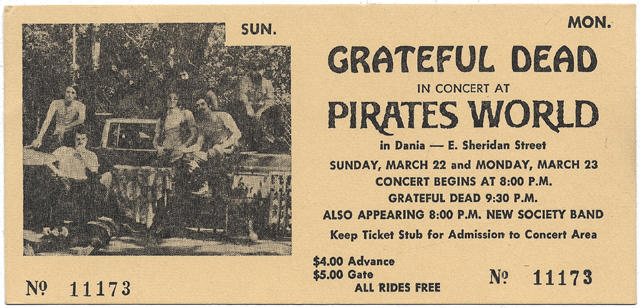
Deadlists shows the Pirate's World show as Tuesday, March 24, but an alert Commenter has pointed out that the extant ticket stub (above) lists shows on March 22 (Sunday) and March 23 (Monday) and none for Tuesday March 24.
Pirate's World was an amusement park in Dania, FL, just North of Miami. There had been a variety of efforts to find suitable rock venues in the Miami area in the 1960s, and the Dead had played a critical role, if to little avail. Early in 1968, the Dead had played Thee Image, Miami's own Fillmore, and the band had also kicked off a series of free concerts at Graynolds Park. Later in 1968, the band had played a rock festival in nearby Hallandale (Dec 28 '68) and then, after Thee Image had closed, at a rock festival on the Seminole Indian Reservation in West Hollywood (May 23-24 '69),and at a speedway in Hollywood (Dec 28 '69). By 1970, police and civic pressure had forced touring rock bands to play outdoors in the Pirates World amusement park in Dania, just North of Hallandale (and just South of Fort Lauderdale). Note that the ticket stub suggests that when purchasing a ticket "all rides free." I wonder how "The Eleven" would sound on a roller coaster?
A Commenter elsewhere recalled
The concert area at Pirates World was inside the large amusement park. Maybe 2,000 people? 100 feet of floor space between the stage and a row of wooden bleacher seats that faced the stage. Totally open air, don't even think there was a roof over the stage.The odd sequence of shows suggests that the Dead were flying to shows and then flying back home to work on the album. I doubt they bought that much equipment with them.
March 27, 28 or 29, 1970: Winter's End Festival, Orlando, FL (canceled)
JGMF discovered an ad for a rock festival in Orlando, FL on the weekend of March 27-29. As a Commenter has observed, it may be that the Dead scheduled in the Festival date and then added the Pirate's World shows as filler. The canceled show would explain the otherwise empty weekend.
March 30, 1970: The Matrix, San Francisco, CA: Jam Session with Howard Wales
There was a nine day gap between the Pirate's World show and the next Grateful Dead show, which was in Cincinatti, OH on April 3. That show, too, was a sort of one-off, leading me to think the band was flying to shows with comparatively minimal equipment. However, the length of that gap suggests that it was very likely that Jerry Garcia went over to the Matrix on Monday, March 30 to jam with Howard Wales and Bill Vitt. If Garcia had been cloistered in the studio mixing Workingman's, I'm sure he would have been in the mood to let off steam by going over to the Matrix and play some weird space music with Wales and Vitt.
The interesting thing about the March 30 is not whether Garcia showed up, since I'm pretty sure he did, but whether it was the night that John Kahn first showed up as well. The long partnership of Garcia and Kahn began around this period at the Matrix, but as I discussed elsewhere, I can't tell for certain whether Kahn first showed up on March 30, April 6 or April 13. A symphonically trained bassist named Richard Favis actually played one night (invited by Vitt), who did not work out, so Vitt invited Kahn. My own guess is that April 6 was Kahn's first night jamming with Garcia, but it's impossible for me to be certain at this time.
March 1970 was an intriguing month for the Grateful Dead and Jerry Garcia: they played some interesting shows, they finished working on an important album, and Garcia used a New Riders hiatus to set himself on a critical path in his own career. Until some intrepid researcher can come close to determining Garcia and the band's precise studio timeline for Workingman's Dead, the chronology of the month and thus Garcia's live activity will remain a bit murky.