Showing posts with label Allman Brothers Band. Show all posts

Friday, August 21, 2026

The Grateful Dead in The Outer Boroughs 1969-75

The ghostly Unisphere globe celebrating the New York State Fair Pavilion in Flushing Meadows-Corona Park in Queens from the New York World's Fair in 1964, as it appeared on November 13, 2013

The Grateful Dead, Outer Boroughs, New York City 1969-75
The Grateful Dead were founded and first became famous in San Francisco, but their next major landfall was Manhattan. Way back when, there was underground buzz about the Dead, so they became an item in Greenwich Village, first at the Cafe Au Go Go and then at the Fillmore East. As the '60s wore on into the '70s, they became an attraction elsewhere in Manhattan, namely Mid-town at the Academy of Music, which became the Palladium, and then at the Felt Forum, and ultimately at Madison Square Garden itself. At the same time, the Dead became huge in the suburbs surrounding New York Metro, in Long Island, New Jersey and Connecticutt. By the 1980s, the Dead were huge throughout the Northeast Corridor--Philadelphia, New England and Upstate New York were conquered territories.

Yet the logic of rock concert touring in the latter part of the 20th century was about following the census. If there were people, bands needed to go there, because there were young rock fans who wanted to see them. So even if a band made its bones in, say, Boston, they had to move on to Chicago, LA, Miami, wherever the kids were, because that's how you made it big. The Grateful Dead certainly followed this model throughout the '70s, expanding their SF/Manhattan anchors to North Carolina, Oregon, St. Louis and wherever there were hippies looking for something different. It would seem, then, that since Manhattan--per the 1990 Census--only had 20% of New York City's population, the Grateful Dead would extend their concerts into the other boroughs. And yet, save for a few brief early forays, no such things happened. The Dead pretty much only played Manhattan, however popular they may have been in Brooklyn and Queens, much less the Bronx or Staten Island.


There are various facets to the history of rock and roll, but they are not always what you think they are. One largely overlooked factor is the history of civic transport. How do people get around in a city, and how do they get to the next city over? There are many facets to this, and one of the best primers for this is Reyner Banham's 1971 book Los Angeles: The Architecture Of Four Ecologies. Banham, a famous English Architecture critic, and faculty at the UCL Bartlett School, SUNY Buffalo and UC Santa Cruz, is not usually noted as a rock and roll archaeologist. But trust me: it's all there. 

Banham's essential insight in Four Ecologies was how the railroad defined Los Angeles's cultural geography, even when the railroad itself was no longer dominant. With respect to New York, the City as we know it was defined in 1898, when New York County (Manhattan), Kings County (Brooklyn) and Richmond County (Staten Island). Bronx County became distinct from Manhattan in 1914. Yet the transport system of New York was defined at the turn of the 20th century, and it had defined New York Metro ever since.

New York Public Transit, and particularly the New York Subway, was explicitly designed to bring workers into Manhattan, particularly lower Manhattan (below Central Park, which is around 55th Street). Thus it is easy to get from any of the Boroughs to Mid-town Manhattan or Greenwich Village. It is harder, however, to get from one Borough to another without going through Manhattan. The Theater district in Mid-town (from about 41st up to 53rd St, colloquially referred to as "Broadway") is directly accessible from all Boroughs. Venues like Madison Square Garden (at 32nd St between 7th and 8th Avenue) or Fillmore East (2nd Avenue and 6th Street) had access to the entire city. In that sense, rock was just like other entertainment--the best place for a venue was where it was easiest to get to. The difference between New York and most other cities, however, was that cars were generally a barrier to getting into the city. Thus, instead of a Coliseum with a vast parking lot on the edge of the city, the Garden was at the center of the New York Metropolitan Transit system.

New Jersey Transit controls train travel into Manhattan from New Jersey, including the PATH train from Jersey City. Trains use the Hudson Tunnel to go directly from New Jersey to Penn Station. Long Island Railroad (LIRR) trains also go to Penn, and Metro-North trains go into Grand Central.

The centralizing effect of the Subway for New York entertainment was magnified many times for the suburbs. The "Tri-State Area" that includes Long Island, Westchester County, Northern New Jersey and Southern Connecticut all depends on rail connections into Manhattan. Commuting suburban workers drive to their local train station to go into Penn or Grand Central Stations, and take the subway to their office. Lower Manhattan is an easy commute for suburbs that surround the city for a 50-mile radius. Commuting into the other boroughs, however, runs against the design of the rail system. So major touring rock bands looking to get suburban fans to come into the city needed easy access to those commuter hubs, and that meant Penn Station (34th St and 8th Ave), Grand Central Station (42nd St and Park Ave) or Port Authority Bus Terminal (42nd and 8th Ave). There weren't major rock venues in Borough other than Manhattan because the transit system ensured that venues needed to be in lower Manhattan in order to thrive. 

For all that, the Grateful Dead did play a few shows outside of Manhattan. This post will look at these rare occurrences, and consider why each venue rarely booked the Dead or its constituent band members. While this post may seem to be about a touring rock band, it's really about transit and how it affects the history of rock music, but that is a subject well worth examining. 

A comparatively recent photo of the Paradise Theater at 2413 Grand Concourse in the Bronx. The Grateful Dead did not play there in 1968. More's the pity.

June 12-13, 1968 Paradise Theater,  Bronx, New York, NY: Grateful Dead (Wednesday-Thursday) (cxld)
The Grateful Dead's New York City debut had been a two-week booking in June, 1967 at the Cafe Au Go Go in Greenwich Village (June 1-11). The band had managed to fit in free concerts as well, immediately making their mark on the local scene. The Dead would return in December to play a few more shows in the Village. In March, 1968, the premier rock booking was Bill Graham's Fillmore East, also in Greenwich Village.

Touring rock bands have to plan at least 90 days in advance, however, and when the Fillmore East opened, the Dead were Bill Graham's competitors. The band was running the Carousel Ballroom in direct conflict with the Fillmore, so they weren't eager to play for Graham in New York. Thus the Dead's next New York Metro gig, while in the Village, was at a dance club called The Electric Circus, on May 7-9, 1968. The show would have booked around March, at the peak of the competition between Graham's Fillmore and the Carousel. There is trace evidence that the Dead also booked a show at the Paradise Theater in The Bronx for two weeknights in June. They must have been planning a weekend gig somewhere else, probably outside New York.

By June of 1968, however, the Dead's operation at the Carousel was falling apart, and they had agreed to a weekend debut at the Fillmore East on June 14 and 15. Thus is was no surprise to see that the prospective booking in the Bronx was canceled. Graham, like any promoter, would have had a contract with the Dead that stipulated no show could be advertised within three weeks and 50 miles of the Fillmore East booking. This would not have precluded a free concert--Graham knew more than anyone how that created buzz--but there was no chance that the Dead would play Wednesday and Thursday in The Bronx. However likely or unlikely the booking at the Paradise Theater had been, the Dead weren't playing it. 

The Paradise Theater, at 2413 Grand Concourse in the Bronx, had opened in 1929 as Loew's Paradise Theater. It had 3,885 seats. The theater had a long and storied history as a movie palace in The Bronx, but by the late '60s it was in decline. I have been able to determine that it was used for at least some rock shows in the '60s, but I don't know which bands might have played there or who the promoters might have been. In early '68, the New York Metro rock concert market wasn't settled yet, and no doubt the Paradise in the Bronx could have been a key stop. But the natural transportation gravity favored Greenwich Village, so the Fillmore East became the premier hall for high profile touring '60s rock bands.


The Grateful Dead were not noted on the initial poster for the Staten Island Day Top Festival (above, color) in June 1968, but they were mentioned in the Village Voice ad (below, B&W). In the ad, they "replaced" Steve Paul, who was a promoter and not an artist, so his name must have been a placeholder. The Dead did not appear at the Day Top Festival.


June 16, 1968 Daytop Village, Staten Island, New York, NY: Grateful Dead/others (GD did not play)
On the same weekend as the Dead’s Fillmore East debut, the New York Times had a display ad for an  event in Staten Island that included the Grateful Dead. The event appears to have been canceled, or at least the Dead surely did not play--I think there was little chance that the Dead were ever going to play this event. The ad does fit the notion that the Dead were considering different bookings prior to locking in to the Fillmore East, and some hippies had at least some hope that they might show up. Once the Dead were booked for Graham, however, there wasn't going to be an advertised show in Staten Island the Sunday after Fillmore East. 


July 11-12, 1969 State Pavilion, Flushing Meadows, Queens, New York, NY: Grateful Dead/Joe Cocker/Tribe (Friday-Saturday)
The Grateful Dead's first live appearance outside of Manhattan was the State Pavilion in Queens, at Flushing Meadows. Flushing Meadows is a park in the center of Queens, and it is the site of Shea Stadium, Citi Field (which replaced Shea), Forest Hills Tennis Stadium, the Singer Bowl and a variety of other attractions. It was also the site of the World's Fair in 1939 and 1964. The "World's Fair" was an International Exposition celebrating the achievements, and sometimes the cultures, of nations around the world. The State Pavilion had been constructed for the Fair in 1962, and it was a showcase for the products from different states. The World's Fair was open in 1964 and '65. In 1969, promoter Howard Stein started to use the State Fair Pavilion for live rock concerts. It had a capacity of about 3000, and excellent subway and bus connections to the location. Rock concerts had been put on at the larger Singer Bowl nearby since at least 1967, but in '69 there were also shows at the State Fair Pavilion. 

The State Fair Pavilion in Flushing Meadows, Queens, as it appeared in November 2013. The Grateful Dead played two nights on July 11-12, 1969

The Grateful Dead have played many long-gone venues throughout the United States. The State Fair Pavilion is somewhat different, however, in that although it has not (to my knowledge) been used since 1969, it is still intact. My photo above is from 2013--I don't think it has materially changed since then. For that matter, I don't think it has changed since 1969. It is an enclosed arena, but with pavilion "overhangs" (if that is the correct word--see above) and a 226-foot tower on one side. Different states had elaborate displays under each pavilion. For rock concerts, I think the configuration was just a stage and an open area, but with the different overhangs providing wanted or unwanted interference.


The 226 foot tower rises above the State Fair Pavilion in Flushing Meadows.

To my knowledge, there was only a few shows at the State Fair Pavilion in Summer '69, and it was never used again. The Grateful Dead seem to have inaugurated the venue on the weekend of July 11-12. The band was also scheduled to play September 26-27, but the last show at the Pavilion was Iron Butterfly on September 19-20. On the weekend of the 25th, the Dead ended up playing the Fillmore East with Country Joe and The Fish. The State Pavilion shows were fairly well attended as far as I know, but I have no idea why the city stopped allowing it to be used as a rock venue. I believe it has been dormant ever since.

Two important relationships came out of the Dead's performances at the State Fair Pavilion. Promoter Howard Stein would book the Grateful Dead in Port Chester in suburban New York starting in March 1970. After that he would book the band at the Academy Of Music, later called The Palladium, throughout the 1970s. More prosaically, a local Queens teenager hired for security at the Pavilion was one Steve Parish, who would meet the Dead's crew backstage. Shortly afterwards Parish came West, and stayed, so Queens had a permanent place in the Grateful Dead universe.


September 26-27, 1969 Stave Pavilion, Flushing Meadows, Queens, New York, NY: Grateful Dead (cxld)
As noted above, the Grateful Dead were advertised in the Village Voice for a weekend at the State Fair Pavilion on September 26-27, but they ended up playing Fillmore East. Whatever was exactly transpiring, the Pavilion shows were canceled early enough for Bill Graham to advertise the Grateful Dead at Fillmore East in the Village Voice prior to the shows. The September 11 Voice (with a publication date of something  like September 7) had Country Joe and The Fish with Mountain, but by September 18 the Dead were advertised as opening for Country Joe. So there was an orderly shutdown. Since the venue was never used again, I have to think that there was a permit or safety issue, rather than a purely economic one.

October 12, 1969 Prospect Park, Brooklyn, New York, NY: Grateful Dead (GD did not play)
JGMF found a Village Voice mention of the Grateful Dead's prospective appearance at a Brooklyn Be-In. The Voice said "A be-in, called 'Discover the New Worlds,' will take place in The Meadow, Prospect Park, between 1st and 2nd Streets, on Sunday, October 12, beginning around noon. Live music will be featured, with The Grateful Dead, Gypsy, and Dust." Prospect Park is Brooklyn's second biggest park. I don't know if there was a Be-In on that day, but the Grateful Dead surely didn't play if there was. 

October 10, 1970 Colden Auditorium, Queens College, Queens, New York, NY: Grateful Dead (Saturday)
By October 1970, the Grateful Dead had some traction, thanks to Workingman's Dead getting regular airplay on FM radio around the country. Still, the band was broke and they were touring as hard as they could to try and get ahead. Oddly enough, the band began their October tour with a Saturday night college gig in Queens. Since this was followed by a night (possibly, but not certainly, two) at a Junior College in New Jersey (Oct 11 and maybe 12), and then shows in Philadelphia (Friday Oct 16), Cleveland (Saturday Oct 17) and double shows in Minneapolis (Sunday Oct 18) on consecutive nights. In between, Garcia seems to have played two nights at the Matrix (Oct 13-14).  It doesn't make much sense in retrospect. 

My assumption here was that since the Grateful Dead were touring without a sound system--rare for them--but rather depending on their local promoters to provide one,  they could fly into shows with just their guitars and a little backline gear, and a small crew. Flying from Philadelphia to Cleveland to Minnesota makes sense if there's very little equipment. Garcia may have been finishing up American Beauty, approving final mixes--perhaps the whole band was--so returning to SF might have been cheaper than hotels. 

Queens College had been established in 1937, and by 1970 was part of CUNY (City University of New York). In 1970, the school had also adopted an "Open Admissions" policy, allowing any New York High School graduate to attend regardless of scores and grades. So, no matter what, Queens College was a forward looking place at the time. There were probably about 15,000 undergraduates in 1970. My guess is that since it was a college booking, the fee was somewhat subsidized by more than just ticket sales, and was guaranteed in a way that no hippie rock-n-roll promoter could ensure. That would have made it well worth it for the band to fly out for a Saturday night show. Colden Auditorium had been built on the campus in 1961, and had a capacity of 2,085.

November 11-14, 1970 46th Street Rock Palace, Brooklyn, New York, NY: Grateful Dead/New Riders of The Purple Sage (Wednesday-Saturday)
The last serious effort to undermine Manhattan hegemony for rock promotion was the 46th Street Rock Palace in Brooklyn, NY. The 3000-capacity former Loew's 46th Street Theater, first opened in 1927, had been converted into a rock venue, similar to Fillmore East. The venue was located at 46th Street and 11th Avenue in Brooklyn, near Alben Square. The venue booked some of the top touring acts: The Byrds, The Youngbloods, the Dead, Jefferson Airplane and others. The venue was only open for a few weeks. 
 
The Grateful Dead were booked for 4 nights, but the shows were thinly attended. There were plenty of Grateful Dead fans in New York City, and plenty even in Brooklyn, but for whatever reasons fans did not come to the 46th Street Rock Palace. The venue seems to have closed shortly after the Dead shows. The venue was used again in early 1973, re-named Bananafish Gardens. It was used for taping some live performances for ABC In Concert, but its not clear how many other times the venue was used. In any case, although the Fillmore East closed after June, 1971, it was not superseded by any Brooklyn venue.
 
December 7, 1970 Brooklyn Academy Of Music, Brooklyn, New York, NY: Touchstone (estimated date)
Organist Tom Constanten had left the Grateful Dead by mutual agreement at the end of January, 1970. By the end of the year, TC was playing in a theater show called Tarot that featured mime Joe McCord backed by a rock music ensemble. Constanten, along with Jerry Garcia, had intermittently backed McCord in the Bay Area when the show was known as Rubber Duck. Now they had a regular gig in Brooklyn, at the Brooklyn Academy Of Music (at 30 Lafayette Avenue). United Artists would sign the backing band (including TC) to record an album called Tarot, under the band name Touchstone. One night in December 1970, Garcia showed up and played pedal steel guitar as part of the band. Few audience members noticed, not there were likely that many. The exact date is uncertain, but it seems to be around December 7.


An ad for Howard Stein's weekend shows at Gaelic Park in the Bronx, during the Summer of 1971. The Grateful Dead played Thursday, August 26.

August 26, 1971 Gaelic Park, Bronx, New York, NY: Grateful Dead (Thursday) Howard Stein Presents
The Grateful Dead had one more venture into an outer borough, although it was a Manhattan-centric booking. Promoter Howard Stein had moved his operation from the State Fair Pavilion in Summer '69 to the Capitol Theater in Port Chester, at the Northern edge of Westchester County. Westchester is the county just North of the Bronx, and Port Chester itself is right next to Connecticut. So the Capitol Theater served Deadheads in the Westchester County and Connecticut suburbs while still being in range for the harder core of New York Metro fans. The location of the Capitol mirrored the development of rock venues around the country, moving to the suburbs nearer to the rock audience, and away from the funky underground bohemian city neighborhoods. The Grateful Dead started playing for Howard Stein at the Capitol in March, 1970, and played numerous legendary gigs at the small, 1800-seat venue.  
 
Stein also promoted shows at venues other than the Capitol, including shows in Boston and Manhattan (the Dead played Manhattan Center for Stein in April 1971). By June, 1971, however, Bill Graham had closed out his Fillmore East, leaving Manhattan open for other promoters. Howard Stein was one of the ones who stepped into the breach. Stein would take over an old movie theater called The Academy Of Music at 126 E. 14th Street. In September 1976, Stein would change the name of the Academy of Music to The Palladium. The Grateful Dead would play for Stein at both the Academy (March 21-28. 1972) and The Palladium (April 29-May 4, 1977). Before that, however, Stein put on some outdoor shows at Gaelic Park in the Bronx, halfway between the Capitol and the Academy of Music, and the Dead played there in the Summer of 1971.
 
Gaelic Park is at 201 W. 240th Street, on the Northern end of The Bronx. The park is about midway between the Capitol Theater in Port Chester (19 miles away) and the Northern edge of Manhattan (for context, Yankee Stadium is at 161st Street). The fine print of the ad for the Summer 71 concert series (above), describes the venue, for those outside the Bronx itself

Gaelic Park is outdoors on the grass with room to dance in the open space or to stretch out on an old blanket. New acoustic artists will entertain at twilight and headliners will carry you into the night, under the stars. The sound, lighting and general production will be provided by the staff of the Capitol Theater.

While Gaelic Park can accommodate twenty-five thousand people, we are limiting sales to fifteen thousand. It will be easy, comfortable and unhassled.

Gaelic Park is close to Manhattan in the Riverdale section of the Bronx. It is easily accessible by subway on the IRT Line (7th Ave Broadway #7) and by car on the Major Deegan, Van Cortland Park exit.  

The last paragraph frames the marketplace. It describes the Park as "close to Manhattan" and gives subway directions, for city dwellers, and describes the driving route for suburbanites. I'm sure that Stein was aiming to attract Dead fans from all over New York City, but the nature of transit was that everyone would know how to get to Manhattan, and the directions only describe Manhattan-to-Gaelic Park. 
 
As far as I know, the Grateful Dead drew fairly well at Gaelic Park. Nonetheless, they would never play an NYC show outside of Manhattan again. Initially, however, their absence from the Boroughs actually represented a hiatus from Dead shows in New York City itself. The Dead would play six out of seven nights for Howard Stein at the Academy of Music in March, 1972 (Hot Tuna filled the other night), and then the band did not play anywhere in New York City until 1976. So they didn't just skip Brooklyn, Queens or The Bronx, but Manhattan as well. New York Metro Dead shows were in the suburbs: Nassau Coliseum, in Long Island, or Roosevelt Stadium and the Stanley Theater in Jersey City and other surrounding areas. But not in the City itself. 
 
Unlike most legendary '60s bands without a hit record, the Grateful Dead got more popular in the '70s, rather than less. They did return to Manhattan, first at the Beacon (June 1976), then at The Palladium (May 1977) and finally at Madison Square Garden. The lure of Manhattan was dependent on New York City transit, and all trains led to Manhattan. The Dead would play the suburbs, and they would play Manhattan--ultimately just Madison Square Garden--but they would not re-appear in any outer Borough, no matter how many fans they had out there.
 
Aftermath
The Grateful Dead's touring history had sequels. The New Riders of The Purple Sage were booked by Sam Cutler and Out-Of-Town tours, and both Jerry Garcia and Bob Weir also toured regularly. So there were a few more appearances in the Outer Boroughs by band members, even though the Grateful Dead would remain rooted in Manhattan.
 
April 29, 1972 [venue], Bayside Community College, Bayside, Queens, New York, NY: New Riders of The Purple Sage/Tranquility (Saturday)
In 1972 and '73, Sam Cutler was the exclusive booking agent for the Grateful Dead as well as the New Riders of The Purple Sage. From the point of view of Dead fans around the country, while the Riders didn't rise to the level of the Dead, they were still popular and one of the few ways to get that San Francisco vibe. Even so, the New Riders only played the Outer Boroughs twice in the Cutler era.

Bayside was 222-05 56th Street in Bayside, in Queens. The school had been founded in 1959, and by 1965 it was part of CUNY. A Saturday night gig at a Community College followed the Cutler playbook, building fans one gig at a time, while covering expenses. Tranquility was an English band on Epic Records, and the Riders were on Columbia, both owned by CBS. During this period, CBS liked to have bands on their labels share bills, likely to share promotional expenses. Tranquility was in a sort of Beatles/Badfinger vein, and were supposedly pretty good.

July 17, 1972 Gaelic Park, Bronx, New York , NY: Allman Brothers Band (Monday) Howard Stein Presents
Howard Stein was promoting shows again in Gaelic Park in the Summer of '72, although the Grateful Dead did not return. The Allman Brothers headlined Gaelic Park, however, and rather famously Jerry Garcia and Bob Weir showed up to join the Brothers for "Mountain Jam." 
 
Garcia's and Weir's appearances were no spontaneous happening. The Allmans had been booked for Friday, July 13, but the show was delayed until Monday (July 17) due to bad weather. This seems logical, except that the delay was advertised a week in advance in the Village Voice.  On Saturday, July 16, the Grateful Dead had played at Colt Stadium in Hartford, CT, and Dickey Betts, Berry Oakley and Jaimoe had showed up for an epic jam to close the show ("Not Fade Away">"Goin' Down The Road">"Hey Bo Diddley"). According to various eyewitnesses, the word was around that the Dead would show up at Gaelic Park, and Jerry and Bob delivered.
 
The Newsday listing (April 7, 1973) for the New Riders show at Queens College on Monday, April 9

April 9, 1973 Colden Auditorium, Queens College, Queens, NY: New Riders of the Purple Sage 
(Monday) two shows: 7:00 & 9:30pm
The New Riders played two shows in Colden Auditorium at Queens College in 1973. It was a Monday, which is an odd night for a show--possibly it was the beginning or end of an academic Quarter. 
 
April 4, 1975 Whitman Auditorium, Brooklyn College, Brooklyn, New York, NY: Legion Of Mary (Friday)
Jerry Garcia had started to tour around outside of the Bay Area. Garcia and Merl Saunders had first played the Bottom Line in Manhattan in July 1974, and again for multiple nights in November '74 and April '75. Right before the April Bottom Line shows, Legion Of Mary played a Friday night at Whitman Auditorium in Brooklyn College. Brooklyn College, on Bedford Avenue, is also part of the CUNY system. It currently has 15,000 undergraduates, although I don't know if it had that many in the 1970s. Whitman Auditorium, built in 1955, seats around 2,300. 
 
October 30, 1975 Colden Auditorium, Queens College, Queens, New York, NY: Jerry Garcia Band w/Nicky Hopkins (Thursday)
The Jerry Garcia Band did a lucrative tour of the East Coast in the Fall of '75, with Nicky Hopkins on board. The Grateful Dead had outgrown Colden Auditorium, but Garcia had now risen high enough to headline it himself. The pattern would repeat itself, and Garcia would not appear in the Outer Boroughs again. 
 
November 14, 1975 Whitman Auditorium, Brooklyn College, Brooklyn, New York, NY: Kingfish/Keith & Donna (Friday)
After the Garcia Band tour, Kingfish and the Keith & Donna Band did a joint tour on the East Coast. They did not draw as well as Jerry, of course, but Northeastern Deadheads were happy for a taste of what they could get. The tour played Friday night at Whitman Auditorium in Brooklyn. Bob Weir would tour relentlessly around the Northeast for the next two decades, but no member of the Grateful Dead would perform in any other Borough but Manhattan until after 1995.

Previous Post:
The Grateful Dead on US-99 1966-69 (Central California I) 


Friday, March 25, 2022

May 27, 1973 Ontario Motor Speedway, Ontario, CA: Allman Brothers Band/Grateful Dead/Waylon Jennings (What Might Have Been)


May 27, 1973 Ontario Motor Speedway, Ontario, CA: Allman Brothers Band/Grateful Dead/Waylon Jennings/Jerry Jeff Walker (Sunday) Bill Graham Presents--canceled
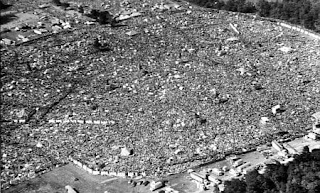
The biggest rock concert in American History was the "Summer Jam" at Watkins Glen Grand Prix Racecourse in Watkins Glen, NY, where 600,000 fans saw the Allman Brothers Band, the Grateful Dead and The Band perform on July 28, 1973. Three-quarters of those fans got in for free, however, as the crowd overwhelmed the fences. The highest paid attendance at any concert was the next Spring, at Ontario Motor Speedway in Ontario, CA, 35 miles East of Los Angeles on April 6, 1974. 200,000 or more fans fans, at least 168,000 of whom paid, saw Emerson, Lake and Palmer, Deep Purple and The Eagles headline over a slew of other popular bands.

Yet on Memorial Day weekend in 1973, on Sunday May 27, Bill Graham Presents had booked the Grateful Dead and the Allman Brothers at the Ontario Motor Speedway. It would have been the first show at the Speedway, and the first time the Dead and the Allmans had been booked together since the Fillmore East in 1970. The show was abruptly canceled, almost certainly due to tepid ticket sales. Yet the paired booking and the venue would prove to be the biggest winners in the history of rock. What happened? 

This post will review what we can determine about Bill Graham's grand plans for the Ontario Motor Speedway on May 27, 1973, and why he was too early.


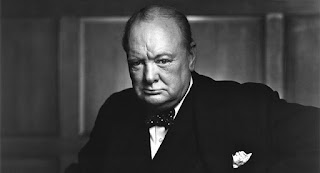
Winston Churchill ca. 1946

Winston Churchill was famously reputed to have said of his decisions in World War 2 that "History will be kind to me, as I intend to write it." It is largely forgotten now that the perpetually-broke Churchill made his living as a best-selling author of history books, so this was no casual assertion. [For the record, Churchill's actual quote was "For my part, I consider that it will be found much better by all Parties to leave the past to history, especially as I propose to write that history"]. Giant figures in rock music, notably Bill Graham, implicitly took Churchill's adage to heart. Graham is widely viewed as the greatest rock concert promoter in the 20th century, a view widely promulgated by Bill Graham. It isn't untrue, by the way--it's just that Bill made sure that the entire rock world heard his version of events first and loudest.

Bill Graham's modern twist on Churchill, however, was not as an author but as an interview subject. Graham gave more interviews than perhaps all rock promoters put together, always had a great story, told them well, and never told a provable lie. Sure, sometimes he favored his own interpretation of events. Every journalist and rock star biographer told Bill Graham's version of the story, and the very best of Graham's practices and innovations--and there were many, to be sure--took front and center, cementing Graham's legacy forever. Rock History was indeed kind to Bill Graham, but he was instrumental in the composition of that history.

In the Spring of 1973, Bill Graham took a big swing in the Southern California rock market, planning to put on the biggest concert in regional history. He struck out, massively. He never mentioned the event again, not in a meaningful way, and the story disappeared. In retrospect, Bill actually looks pretty good: he was absolutely right about everything, but he was just a little bit early. But that wasn't the story he wanted to tell, so he didn't tell it. Only the bare outlines remain.


Rock Festivals and Major Rock Venues: Status Report early 1974

Rock Festivals were a product of the 1960s. Gina Arnold's excellent 2018 book Half A Million Strong (University of Iowa Press) tracks how "free shows in the park" evolved into "giant multi-day events in some farmer's muddy field" over the course of a few years (yes, she's my sister but you should still read it). By the time of the biggest festivals of 1969 and 1970, most famously Woodstock, hundreds of thousands of people would come to some outlying area and camp out for several days, while live rock music blasted 24/7. Legendary as these events were, most fans did not attend more than one giant event, and most communities that endured a huge rock festival did not tolerate a second one.

The live rock music business got bigger every year, and various efforts were tried to find a way to have "festival" events on a large scale. Multi-act events were appealing to promoters because they inherently hedged risk in a volatile music market. Since shows had to be planned many months in advance, it was hard to anticipate how one band might have a breakout hit, and how another may have become over the hill, or even broken up, in the few short months between booking the show and playing it. In early 1969, for example, Led Zeppelin found themselves playing tiny auditoriums, sometimes as the opening act, with their debut album roaring up the charts, while at the same time Vanilla Fudge found themselves no longer the draw they had been the year before. A rock festival, with dozens of acts over a few days, could more easily absorb the hits and misses. Promoters continued to search for a way to book multiple acts profitably.

An aerial shot of the Watkins Glen Grand Prix Course on July 28, 1973, with some of the 600,000 fans in attendance at the Allman Brothers/Grateful Dead/Band rock concert

Rock Concerts at Auto Racing Tracks
The immediate and vast popularity of rock festivals posed a very specific land-use problem. Places like Indian Reservations and farms were not really viable for major, multi-day events, since too many things could go wrong. Equally importantly, despite or because of the increasing crowds, it was all but inevitable that rock festivals would become "free concerts." Liberating as this may have seemed at the time, it ensured that the events could not make enough money to provide a safe, repeatable event for bands, patrons and host communities. The financial opportunities of rock festivals were huge, however, and since nothing says "rock and roll" like "land use," over the years there was a concerted effort in the concert industry to find spaces that could successfully and profitably host occasional, loud outdoor events with giant crowds.

One of the intriguing solutions for hosting giant rock festivals was to use facilities designed for auto racing. Race tracks were usually somewhat removed from urban areas while still being near enough to civilization to attract a crowd. Auto races themselves were noisy, and major race events tended to occur just a few times a year and last an entire weekend, just like a rock festival. Since race tracks were permanent facilities, they generally had fences, bathrooms, water, power and parking, so in many ways they would seem like ideal venues for huge rock events. Indeed, some of the major rock events of the 1969 and the 1970s were held at race tracks. 


Two of the most successful rock festivals were held at Dallas International Speedway and Atlanta International Raceway, both organized in 1969 by promoter Alex Cooley. Both tracks were giant NASCAR "super-speedway" ovals.  The Rolling Stones' debacle at tiny Altamont Speedway might not have happened had it been held at its original site, the newly-opened Sonoma Raceway, then a newly opened Road Course in rural Sonoma County, near the San Francisco Bay. 

I looked at some of the history and economic dynamics of Auto Racing tracks as Rock Concert sites in another post, although for purposes of scale I focused on the Grateful Dead. Generally speaking, while auto racing had been popular since the invention of the automobile, horse racing had been hugely popular in cities and county fairs throughout the United States, long before cars were invented. However, after WW2, when the GIs returned and economy boomed, America moved from its rural roots to a more urban and suburban universe, and the automobile became a more important part of everyone's life. A national boom in the popularity of auto racing corresponded with a slow decline in the popularity of horse racing. 

By the early 1960s, numerous custom-built facilities served the hugely popular auto racing industry, with oval tracks (for NASCAR and "Indianapolis" cars in the South and Midwest), road courses (for sports cars on both coasts) and dragstrips (nationwide). These facilities were actually ready-made for rock concerts, but there were some huge cultural divides. With a middle-class family audience for auto races, and their Dow Industrial sponsorship from major companies, racetrack promoters were neither tuned into nor inclined to sponsor long-haired outlaw rock concert events flaunting nudity and drugs. 

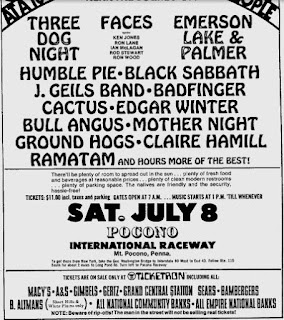
On July 8, 1972, Concert 10 presented a multi-act rock show at Pocono International Raceway in Long Pond, PA. Due to a huge rainstorm, the headliners did not appear until the dawn hours of July 9. The fine print says "the natives are friendly and the security, hassle-free"

Rock Concert Economics: 1973

In 1973, there was a huge audience for live rock music, but that audience was young, and without much ready cash. Also, since rock music stood for "rebellion," the most popular of rock music attractions were vulnerable to the complaint that they were charging "too much" for tickets. The inevitable result of these pressures was that popular rock bands put on concerts in larger and larger venues, instead of charging more at smaller places. By 1973, the most popular bands were selling out basketball arenas with capacities of 12,000 or more, even in so-called "secondary" markets. Ticket prices were reasonable, around 4 or 5 dollars usually, but the total number of tickets sold was larger than ever.

By the early 70s, multi-act "Festival" shows had mostly been financial debacles and public relations disaster, and it wasn't just Altamont: check out the saga of the "Erie Canal Soda Pop Festival" in Griffin, Indiana on Labor Day weekend of 1972. Smart promoters were looking for other workable venues, and race tracks re-appeared on the horizon. An interesting thing to consider about auto racing was that--because of the noise--they had to generally be well outside any populated areas, but still within driving distance of a lot of potential fans. At the same time, since fans had to drive a fair amount, a race track generally offered a whole slew of races during a weekend at the track, not just a headline race. These economics pretty much defined multi-act rock concerts, just for a different, younger fan base.

On July 8, 1972 there had been a huge multi-act rock festival at Pocono Raceway in Pennsylvania. Pocono Speedway, in rural Long Pond, was nonetheless in driving distance for a huge population of teenagers in greater Pennsylvania and parts of Northern New Jersey. Pocono Raceway was less than an hour from Scranton, Allentown and Nazareth, and about 90 minutes from the suburbs of Philadelphia and Newark. There was a huge population of suburban rock fans with access to their parent's cars. 120,000 fans showed up to see Emerson, Lake and Palmer, Faces, Humble Pie, Three Dog Night and and numerous other bands, completely overwhelming the facility. The interest was there.

The parallel development at this time was rock concerts at football or baseball stadiums, full-size major league ones. There had been experiments with stadiums going back to the Beatles, but they had been unsatisfactory. The live rock music audience had gotten bigger, however, and sound systems had improved as well. The first "modern" rock concerts at football stadiums were on May 4 and 5, 1973, when Concerts West hsd produced Led Zeppelin shows at Tampa Stadium and also at Fulton County Stadium in Atlanta. Upwards of 40,000 fans attended each concert. All fans bought tickets, too, setting paid attendance records at the time for such venues. Uniquely, Led Zeppelin were the only act for both shows, with no opening bands. 

The rock market was finding new mega-venues, and Bill Graham wasn't going to be left out. Graham was a self-promoter, yes, but he thought big--he was going to break in two mega-venues of his own, one at home in the Bay Area and the other down in Southern California.

Bill Graham was the king of concert production in San Francisco, but he had only occasionally put on shows in Los Angeles. Southern California did not have a dominant promoter, however, so there was still room for Bill to operate. To do that, however, he needed to make a splash, and to make a splash he needed a place. It looked like that place was the Ontario Motor Speedway, an innovative and newly constructed auto racing track that had only opened for full-time racing in Summer 1970. 

The city of Ontario, CA, had been founded in 1891, and named by transplanted Canadians. Ontario is 35 miles East of Los Angeles, and 23 miles South of San Bernardino. Part of San Bernardino County, it is on the Western Edge of the proverbial Inland Empire. Ontario had been the site of a World War 2 Army Air Force Base, which remained an Air National Guard base after the war (and would remain so through 1995). The airport had also been established for civilian use in 1946 as Ontario International Airport. The Airport was joined to LAX in 1967, and jet flights had begun at the airport in 1968. Although Ontario only had a population of 64,118 in the 1970 census, as a result of the airport and the airbase it was at the nexus of a substantial freeway network. I-10 and I-15 met at Ontario Airport, so all of Southern California could get there easily.

Auto racing was booming in the 1960s, yet Los Angeles was underserved by facilities. Yes, there was the epic Riverside Raceway, another 25 miles East, but that made it even farther from LA proper. More importantly, Riverside was just a road racing facility--albeit a great one--and that limited the types of major events that could be held there. Ontario Motor Speedway was conceived as a full-service answer to every auto racing sector in the Los Angeles area, in a location near the city. The airport location was crucial, too, since major auto racing teams barnstormed around the country like touring rock bands, and drivers and even their race cars were often flying directly from track to track. 

Ontario Motor Speedway was custom built to provide first class facilities for all the major types of racing: an oval for NASCAR and Indianapolis cars, a road course (that included part of the oval) for road racing and a dragstrip. Besides advanced pit facilities, OMS also pioneered what we now call "clubhouses" and "luxury suites" for sponsors. It was a well-conceived endeavor. The plan was to have not only top level NASCAR and USAC (Indy Car) 500-mile races, but Formula 1 and NHRA Drag racing. The inaugural race was the (Indy Car) California 500 on September 6, 1970, with paid attendance of 178,000, a huge crowd even by auto racing standards. Jim McElreath beat out an All-Star field of drivers that included Mario Andretti, A. J. Foyt, Dan Gurney and the Unser brothers.

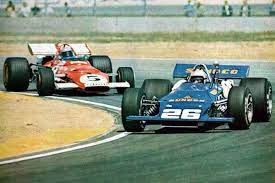
Mario Andretti (5) in a Ferrari 312B F1 car, about to lap Mark Donohue (26) in a Lola-T192 Chevy F5000 car. Andretti would win the Questor Grand Prix, the only F1 race at Ontario Motor Speedway, on March 28, 1971

After a hugely successful opening, however, Ontario Motor Speedway had a number of events in 1971 and '72 that did not live up to financial expectations. The racing was great--it was the early 70s--but after the September '70 opening, the Speedway didn't catch LA like it should. The big plan was that Ontario would host a 2nd United States Grand Prix, which hitherto had been the exclusive province of Watkins Glen in New York. As a prelude, Ontario Motor Speedway held a non-Championship Formula 1 race, the Questor Grand Prix, on March 28, 1971, won by Mario Andretti in a Ferrari 312B. The event was a financial bust, however, and Formula 1 cars never ran at Ontario again (ultimately Long Beach, CA, would get the second US Grand Prix). Although 1971 went alright, the 1972 Ontario attendance, despite great racing, were a financial letdown. Thus by 1973, Ontario Motor Speedway would have been open to the possibility of different promotions. 

Anaheim Stadium, Anaheim, CA July 10, 1973

Southern California Stadiums
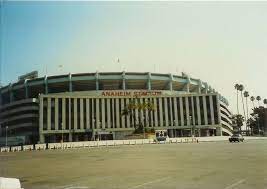
There were plenty of stadiums in Southern California, but none of them were particularly ripe for rock concert promoters. Dodger Stadium was under the full control of the Dodgers, and they didn't share it. The Los Angeles Coliseum was old (opened 1921) and in and was near "undesirable" (read: "too African-American") neighborhoods. The Rose Bowl, in Pasadena, had access and parking issues. That left Anaheim Stadium, in Orange County. But it was just across the road from Disneyland, and The Mouse would not want weekend parking disrupted by hordes of young rock fans. In fact, starting around 1976, Anaheim Stadium would become the primary home of stadium rock concerts in Southern California, with the full cooperation of Disneyland, but that was a few years away. In any case, Bill Graham was from out-of-town, not well-placed to talk local stadium operators into cooperating.

Ontario Motor Speedway was a different matter. It had been well-conceived and well-built, but after initial excitement, the attention had died down--same as it ever was for LA--and it was going to need additional sources of revenue. May 27, 1973 was the Sunday of Memorial Day weekend, and the biggest day for auto racing in America. Since all American race fans would be glued to their Televisions watching the 57th running of the Indianapolis 500, it was a perfect day for Ontario Motor Speedway to try something else. Bill Graham had figured out that he had a perfect venue in Southern California, and more importantly, a venue that needed him and his rock-concert expertise. 

What did the Ontario Motor Speedway offer as a rock concert venue?
  • Its location (35 miles E of LA, 23 miles Southwest of San Bernardino) put in close proximity to tens of thousands of potential rock fans.
  • The convergence of the I-10 and I-15 freeways meant that an even larger pool of rock fans could drive to the Speedway fairly easily, from either San Diego (on I-15) or nearer the Pacific Coast (I-10). Ontario was just outside of Central LA, so the majority of potential fans could circumnavigate the often brutal traffic jams that the region was infamous for.
  • In Southern California, it's always sunny and it never rains, so weather wasn't a consideration.
  • The racing facility had parking for 50,000 cars, and apparently there were satellite lots as well. No need to worry about cars abandoned by the side of the road on some farm road.
  • The grandstands featured 95,000 seats, with 40,000 "bleacher" seats in temporary grandstands, and a substantial crowd could fit on the infield. It was plausible to imagine 200,000 or more fans at an Ontario Speedway rock concert (178,000 had attended the inaugural California 500 race). This was double the capacity of even the enormous LA Coliseum.
  • Ontario Motor Speedway had debt to service and was looking for other sources of revenue, so they would be eager to work with a partner like Bill Graham.
  • Most importantly, the huge grandstands around the track, and hence around the facility, ensured that the facility was cordoned off. That meant it was plausible to ensure that only those with tickets would get into the show. At giant rock festivals, the economic issue was always gate-crashing, but that was usually in some giant, muddy field. The Speedway acted as fence, and entry was through controlled tunnels under the grandstands.
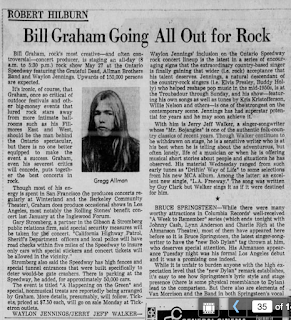
Robert Hilburn's column in the LA Times May 5, 1973

A feature in the Los Angeles Times mapped out the strategy I described above. Robert Hilburn was the Times' principal rock critic, and he had a "Saturday Roundup." On May 5, the Ontario Speedway concert was the primary topic, with a photo of Gregg Allman and quotes from a high-powered public relations executive (remember, in Los Angeles, PR equaled prestige).

Bill Graham Going All Out For Rock (Robert Hilburn, LA Times May 5 '73)
Bill Graham, rock's most creative--and often controversial--concert producer, is staging an all-day (8am to 5:30pm) rock show May 27 at the Ontario Speedway featuring the Grateful Dead, Allman Brothers Band and Waylon Jennings. Upwards of 150,000 persons are expected.

It's ironic, of course, that Graham, once so critical of outdoor festivals and other big-money events that lured rock stars away from more intimate ballrooms such as his Fillmores East and West, should be the man behind the Ontario spectacular, but there is no one better equipped to make the event a success. Graham, even his severest critics will conceded, puts together the best concerts in rock.

Though most of his energy is spent in San Francisco (he produces concerts regularly at Winterland and the Berkeley Community Theater), Graham does produce occasional shows in Los Angeles, most notably The Rolling Stones' benefit concert last January at the Inglewood Forum.

Gary Stromberg, a partner in the Gibson & Stromberg public relations firm, said special security measures will be taken for the concert. "California Highway Patrol, Sheriff's Department officers and local police will have road checks within five miles of the Speedway to insure that only cars with special stickers and concert tickets will be allowed in the vicinity."

Stromberg also said the Speedway has high fences and special tunnel entrances that were built specifically to deter would-be gate-crashers. There is parking at the Speedway, he added, for approximately 50,000 cars.

The event is titled "A Happening on the Green," and special non-musical treats are reportedly being arranged by Graham.


This aerial shot of Kezar Stadium (exact date uncertain)


Meanwhile, Back In San Francisco

Whatever your modern-day view of Bill Graham might be, he didn't think small. In May 1973, Graham was planning to expand his empire with a dramatic entrance into the Southern California market. But he had big plans for Northern California as well. On May 4, information was quietly leaked (through the Hayward Daily Review rock column "KG") that the Grateful Dead would headline two concerts at the Cow Palace on Tuesday and Wednesday, May 21-22. Also on the bill would be Willie Nelson and the New Riders of The Purple Sage. This was a surprising booking on a number of levels.

The Grateful Dead had an extraordinarily loyal audience in San Francisco, but the band wasn't really that big. The Dead had headlined three weeknight concerts at the (officially) 5400-capacity Winterland back in December (Sunday-Tuesday December 10-12), followed by New Year's Eve. Those four shows had sold out without meaningful advertising. Yet the Cow Palace was a 16,000-capacity barn in Daly City, on the outskirts of San Francisco. Were there really enough Dead fans to fill it up for two weeknights? Willie Nelson was a rising star at this time, but he was no proven commodity in the Bay Area. Tickets went on sale, but it almost seemed to be a stealth show.


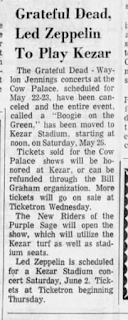
The San Francisco Examiner, May 14, 1973

On Monday, May 14, Graham showed his hand. The two Cow Palace Grateful Dead concerts were rescheduled for Saturday, May 26 at Kezar Stadium in Golden Gate Park. Kezar Stadium, opened in 1925, had been the home of the San Francisco 49ers until the 1971 NFL season. Kezar was now largely unused, but it was in the center of the city and relatively easy to get to by freeway from surrounding counties. On top of that, most Bay Area residents knew how to get to Golden Gate Park, so it was a workable destination. Kezar was small for an NFL stadium (about 60,000), but huge for a concert facility. With no competing sports dates, Kezar would be easier to schedule than an active stadium.

More importantly, the weekend after the Grateful Dead, Graham announced that Led Zeppelin was going to headline Kezar Stadium. As noted, Zeppelin had begun their tour by headlining stadiums in Tampa and Atlanta. Now Graham was going to book Zep's biggest concert on the West Coast. Over the course of just eight days, Graham was planning to put on the Grateful Dead at Kezar (Saturday May 26, with Waylon replacing Willie), the Allman Brothers and the Dead at Ontario (Sunday May 27) and Led Zeppelin back at Kezar (Saturday June 2).

Grateful Dead, Led Zeppelin To Play Kezar (SF Examiner, May 14 '73)
The Grateful Dead-Waylon Jennings concerts scheduled for May 22-23, have been canceled and the entire event, called a "Boogie on the Green," has been moved to Kezar Stadium, starting at noon, on Saturday, May 26.

Tickets sold for the Cow Palace shows will be honored at Kezar, or can be refunded through the Bill Graham organization. More tickets will go on sale at Ticketron Wednesday.

The New Riders of the Purple Sage will open the show, which will utilize the Kezar turf as well as stadium seats.

Led Zeppelin is scheduled for a Kezar Stadium concert Saturday, June 2. Tickets at Ticketron beginning Thursday.
The Grateful Dead/Waylon Jennings show at Kezar drew about 30,000 fans, and was a huge success. The Led Zeppelin show on the next weekend was sold out, drawing twice as many fans. The noise bothered the local neighborhood--the sound system was in a different location than it had been for the Dead--, and Led Zeppelin's fans were not as welcome in the Haight-Ashbury as Deadheads. Bill Graham had proof-of-concept for his "Day On The Green" all-day stadium concerts, but he moved them to the more accessible Oakland Coliseum. They would thrive there for many decades.


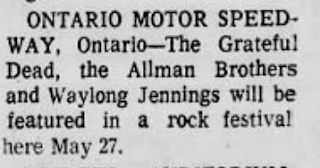
May 12, 1973 Pomona Progress-Bulletin listing

 May 1973 Status Report: Allman Brothers, Grateful Dead, Waylon Jennings, New Riders
The Allman Brothers Band would be the premier attraction at the Watkins Glen Summer Jam concert on July 28, 1973, attracting around 600,000 fans. 150,000 of them even paid. From the Summer of 1973 through the Fall of 1975 the Allman Brothers were one of the premier concert attractions in the country. You can make a good case that Led Zeppelin and Emerson, Lake & Palmer were equally as popular as the Allmans, but they weren't bigger. Now, granted, the Rolling Stones didn't tour and Bob Dylan only played indoor arenas, but the Allmans were a massive outdoor draw all over the country. Watkins Glen was the biggest, by far, but it wasn't a fluke.

Most rock fans from the era recall that Summer '73 was when the Allmans broke through with their mega-hit "Ramblin' Man," a catchy country tune that was not particularly typical of the bluesy jamming on which the Brothers had made their bones. "Ramblin' Man" was reminiscent of "Blue Sky," sure, and maybe "Revival," both of them Dickey Betts songs as well, but it wasn't at all like "Statesboro Blues" or "Whipping Post." So the idea that the Allmans began to dominate the US concert market when they got their big hit single is compelling. But it's wrong. 

The Allman Brothers had a massive successful US tour in the Summer of 1973. The first highlight was an epic double-bill with the Grateful Dead at Washington, DC's RFK Stadium, on the weekend of June 9-10. Yet that event was eclipsed by the triple-bill at Watkins Glen on July 28. Nonetheless, the Allmans' follow-up release to Eat A Peach, which had come out back in February '72, would not even be released until August of '73, after the Watkins Glen show. "Ramblin' Man" was the first single, released at the same time, and it would go on to reach #2 on the Billboard charts. Now, sure, advance copies of Brothers And Sisters and the "Ramblin' Man" 45 were probably on FM radio (or even AM) in late July, but the huge successes of RFK and Watkins Glen were before the album and single had even been released. The Allman Brothers Band were huge because they were huge. FM radio listeners had caught up to them, and FM radio played them constantly throughout 1972 and '73.

The Allman Brothers Band's third album At Fillmore East had been released in July 1971. As America was slowly catching up to their stunning sound, Duane Allman was killed in a motorcycle accident on October 29, 1971. As a result, the band's followup, Eat A Peach, a double-lp that was half studio and half live, received extraordinary (if well-deserved) attention. And if that wasn't enough, Derek And The Dominos had a hit in Summer '72 with the by-now18 month-old "Layla," and Duane's interplay with Eric Clapton drew even more attention to him. The Allmans were in the process of recording the sequel when bassist Berry Oakley died in a motorcycle accident almost exactly a year after Duane (on November 11, 1972). Interest in the Allmans inevitably redoubled. In 1973, Capricorn Records released a double album of their first two records (Allman Brothers Band and Idlewild South) as Beginnings, so the Allmans were all over the radio throughout the Summer, even though they did not yet have a new album. 

The Grateful Dead, meanwhile, had risen above the level of cult status, even if they were only somewhat of a "major attraction." The band had released four gold albums in a row (Workingman's Dead, American Beauty, Grateful Dead ['Skull & Roses'] and Europe '72), and they, too, got their share of play on FM radio. In the case of the Dead, the songs played on FM were likely the more rocking songs in their repertoire (like "Bertha" or "Sugar Magnolia"), rather than big jams like "Dark Star," but they were Dead songs nonetheless. The Dead would leave Warner Brothers to go independent at the end of 72, but they would not release their final record on the label (Bear's Choice) until July of '73.

The New Riders of The Purple Sage no longer featured any members of the Grateful Dead, but they still shared booking and other services with them. By May 1973, the Riders had released three albums on Columbia. The Dead tried to book the Riders as openers when it fit. Clearly, they fit in at Kezar but not Ontario.

Waylon Jennings (1937-2002) was an established country singer, but he had roots in rock and roll. Jennings had been the bass player for Buddy Holly and The Crickets, and had graciously offered to give up his seat on the airplane to The Big Bopper, on the fateful flight on February 3, 1959 that crashed, killing Holly, the Bopper, and Ritchie Valens. Jennings had gone on to success as a Nashville singer, but he had never been happy with how his records were made. By '73, country rock was starting to become a commercially viable enterprise, with the Eagles as the most prominent band, along with a slew of other groups like Poco, the New Riders and Pure Prarie League. The unhappy Jennings, however, tapped into something much more potent than hippies playing rock and roll with a twang.

The more potent and lasting merger of country music and the 60s would be the music coming out of Austin, TX. Genuine country musicians, with proper Nashville pedigrees, would move to Austin, grow their hair, light one up and pretty much play the same music they had been playing before. OK--maybe there was a bit more attitude, but that wasn't incompatible with older roughneck country, anyway. One of the earliest converts was Jennings. 

In 1972, Jennings had had a pretty good hit with the song "Ladies Love Outlaws," and RCA still wanted him to be a typical Nashville artist. By 1973, however, Jennings had moved to Austin, TX, to join fellow outcast Willie Nelson, and RCA finally saw the light. Jennings kept the beard he had grown, and "Outlaw Country" followed, with Willie and Waylon in the forefront. Sharing bills with the Grateful Dead and the Allman Brothers in California was a huge break from country practice. Jennings was consciously and enthusiastically aligning his music with long hair, weed and loud, loud music.

What Happened: Ontario Motor Speedway
On Monday, May 22, Robert Hilburn explained in the Los Angeles Times that the Dead/Allmans/Waylon concert would be canceled. The reason given was that the police were going to insist that the concert end by nightfall, because of some incident at a concert in Stockton.

Ontario Rock Concert Canceled by Graham (Hilburn LA Times May 22 '73)
The all-day Grateful Dead-Allman Brothers-Waylon Jennings rock concert Sunday at the Ontario Motor Speedway--which had been expected to draw upwards of 150,000 persons--has been canceled, producer Bill Graham has announced.

"Trouble with several youngsters at an April 29 outdoor concert in Stockton caused Ontario civic official to take a hard, long look at the May date," Graham, who was not involved in the Stockton event, said. Specifically, police said the concert--the first of its kind at the huge speedway--would have to end three hours before dark, or approximately 5:54pm, he added.

Since the Allmans and the Grateful Dead were scheduled to play several hours each, Graham said he doubted he could honestly end the show by that time." He pointed out the Dead played six hours recently at an outdoor concert in Des Moines, Iowa. Though normally outspoken, Graham made it clear he was not blaming anyone. "All the Ontario officials and police were extremely cooperative. Under the time limits imposed however, I didn't feel we could have given the kids the show we promised.

Graham said he is proceeding with plans to present Leon Russell Aug. 5 at the Ontario facility. Ticket sales for the Sunday event were described as "healthy" by a spokesman for the San Francisco-based producer. 

You can buy this story if you like. Maybe there were some elements of truth to it, I don't know. Here's what I think--the concert didn't sell enough advance tickets, and it no longer made economic sense. Remember, Graham's team would have had to construct a huge stage and a ginormous sound system, and fly the Allman Brothers, the Dead and Waylon Jennings in from out of town.  The Times article says that the concert was "expected to draw upwards of 150,000 patrons." If Graham had those kind of ticket sales, he would have found a way around any police objections (if those objections were real), by paying for better lighting, more security or whatever it took. But I don't think the ticket sales were there. Given that we know that the Allmans and the Dead would pack Watkins Glen just two months later, why could that have been?

Although this fine album was a massive hit, it doesn't shout "Los Angeles Summer of '73" to me

The West and The East

The West Coast and the the East Coast were very different concert markets in the 1970s. The Midwest and the South probably were different, too, but I have done less research into them, so I won't generalize. A characteristic of East Coast events from 1969 onwards was the willingness of large numbers of young people to get in their cars and travel for rock concerts. An event like Woodstock drew not just from New York state but all of New England, Pennsylvania and New Jersey. Population was much more distributed in the East. There were a lot of medium-sized cities full of young people anxious to see major rock bands, and they would travel. The phenomenon of Deadheads driving hundreds of miles to every show originated as an East Coast phenomenon. 

The West, even in California, was considerably less populated in the 1970s. The vast suburbs of Los Angeles, the Bay Area, Fresno and Vegas were far smaller then. It wasn't that young people didn't love rock and roll as much, they surely did, but once you got outside the major metro suburbs, there just weren't that many people. Fresno, to name just one outlying city, had 165,655 residents in the 1970 census, while it would have 542,107 in 2020. There were just fewer young people ready to hop in their parents' cars and see a big rock show. Few Deadheads from San Francisco would have been planning to travel down to Ontario, since the Dead were playing the afternoon before. As for LA, the Dead had already booked three shows at the Universal Amphitheatre on June 29-July 1, so it's not like Deadheads would lose out.

Los Angeles and San Francisco aren't the same, which is what makes California great

Also, while both the Grateful Dead and the Allman Brothers were popular bands, I don't think they were particularly popular in 1973 Los Angeles. Now, sure, there were plenty of fans who liked each band, or both bands. But LA was huge, so any band could sell tickets--Jethro Tull, Black Oak Arkansas, The Yes, you name it. But the Allmans and the Dead were hippie guitar hero bands--was that what was happening and what was going to impress everybody in LA on Monday morning when you got back to school? I don't think so.

Did the Allmans or the Dead have a hit single on the radio? Definitely not. Did this matter in Los Angeles? Well, you decide, but it was the biggest record industry town in the history of the record industry, so I think you had to be super-cool or on the charts, and the Dead and the Allmans were neither. I think ticket sales were tepid, and Graham canceled the show. 

Some months later, in the East it was different. The tens of thousands who bought tickets for Watkins Glen weren't downtown Greenwich Village hipsters, they were kids in Syracuse or Allentown or Parsippany who wanted to see some big time rock bands. None of those bands were coming to their town, and their parents weren't necessarily OK with them driving to Manhattan, but some racetrack out in the countryside? Yeah, why not? The kids could have got permission to go the US Grand Prix, so why not a concert?

Graham's assessment of the Allman Brothers and the Dead as a booking pair was correct, but his location was off by 3000 miles. He was also right about the Ontario Motor Speedway, although he picked the wrong bands. The following Spring, Ontario Motor Speedway would hold the "California Jam" on April 6, 1974, an all-day affair headlined by Emerson, Lake & Palmer, Deep Purple and the Eagles. Actual attendance was well North of 200,000, but more importantly paid attendance was around 168,000, breaking every record known for a paying concert. That record would hold until "Cal Jam 2," also at Ontario Motor Speedway, on March 18, 1978. Cal Jam 2 had at least 175,000 paid.

So the planned May 27, 1973 concert at Ontario Motor Speedway had all the right pieces for an epic success of unimagined proportions, but in the wrong combination. We are left with only a poster.


Postscripts
  • The August 5 Leon Russell concert booked for Ontario alluded to above seems to have been moved by Bill Graham to Oakland Coliseum, the first in what was a decades-long success in outdoor stadium concerts at that venue.  The Grateful Dead show at Kezar (on May 26) was a huge success, but the sold-out Led Zeppelin show did not go over well with the neighborhood, leading to the shift to Oakland Coliseum.

  • update 20240201: it turns out the Leon Russell concert was indeed held at Ontario Motor Speedway, on Sunday, July 29, 1973. This was the first rock concert at the Speedway. Leon had just released his monster hit triple album Leon Live. Per the July 31 Times, around 30,000 showed up, but Bill Graham was expecting 80,000. In a strange bit of symmetry, this was the same weekend as the Dead/Allmans blowout at the Glen, and Leon had originally been booked there. The Dead and the Allmans had preferred The Band, and Leon was bought out of the gig.
  • The first second concert at Ontario Motor Speedway has been entirely forgotten. On November 24, 1973, Three Dog Night and the Guess Who headlined a rainy Saturday at the Speedway. There were several opening acts, something like 25,000 people and per a Dennis Hunt Times review, a miserable time was had by all. It must have served as proof of concept, however, since Cal Jam was held five months later.
  • Bill Graham and the promoters of the Watkins Glen attempted another event at Ontario on August 3,1974, headlined by Crosby, Stills, Nash & Young. Tickets were even sold, but the event was canceled.
  • Ontario Motor Speedway was a well-designed and forward looking auto racing facility, but it did not succeed financially. The Speedway was open from August 1970 to December 17, 1980. Per Wikipedia, by 1980, the Ontario Motor Speedway bonds were selling at approximately $0.30 on the dollar. Generally unknown and unrealized by the bond-holding public, the 800 acres (3.2 km2) of land originally purchased at an average price of $7,500 per acre, had now risen to a value of $150,000 per acre. Chevron Land Company, a division of Chevron Corporation recognized the opportunity to acquire the bonds and effectively foreclosed on the real estate. For approximately $10 million, Chevron acquired land which had a commercial real estate development value of $120 million, without regard to the historic significance or future potential of the speedway.
  • From above, you can still see traces of Turn 3.


Appendix: Where Was Ontario Motor Speedway?

The speedway was bordered on the north by 4th Avenue (then referred to as San Bernardino Avenue), on the south by Interstate 10, the west by Haven Avenue, and the east by Milliken Avenue, which still has the eastward curve needed to make room for turn 1 and turn 2 of the racetrack.   Milliken Avenue is one of (maybe the only) street with curves like this in the entire city. 

Contrary to those news reports about the Ontario Mills Mall being built inside the old racetrack, this is not the case.  Ontario Mills Mall lies across the street, due-east of what was the racetrack, on the east side of Milliken Avenue.  When the Speedway was still in existence, the future home of Ontario Mills Mall was either empty fields, or parking areas, depending on the year. 

Even though virtually nothing remains of the race track, other than some of the raised-berms that made turn number 3 at the corner of 4th and Haven Avenues, The City Of Ontario has retained some of the history and heritage of the racetrack by building Ontario Motor Speedway Park a few blocks west of the racetrack site and by using auto racing inspired street names in and around the old speedway.  Let’s give Ontario some credit for these street names! (Jaguar Way, Corvette Dr, etc)

Appendix 2: Population of Ontario, CA
1960    46,617        103.8%
1970    64,118        37.5%
1980    88,820        38.5%
1990    133,179        49.9%
2000    158,007        18.6%